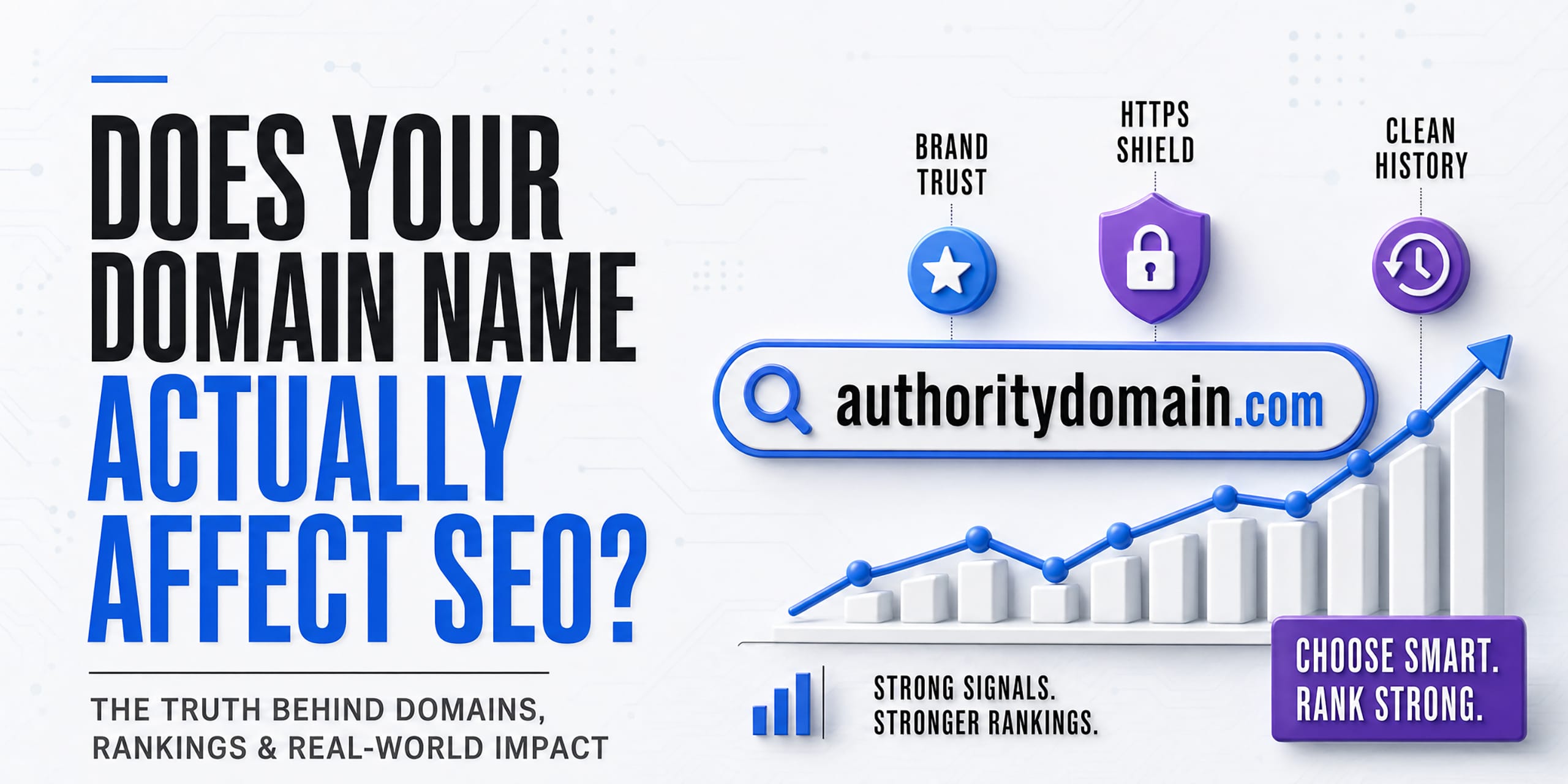
Few questions in the world of SEO generate more confusion, more contradictory advice, and more heated debate than this one: Does your domain name actually affect your search rankings?
Type it into Google, and you will find confident articles arguing both sides. “Your domain name is critical for SEO.” “Your domain name is completely irrelevant to rankings.” “Buy keyword-rich domains to rank faster.” “Keyword domains are dead and could hurt you.”
The truth is more nuanced than either camp admits, and in 2026, with Google’s algorithms more sophisticated than ever, getting this right matters more than ever.
In this guide, we will cut through the noise with official statements from Google, real data from leading SEO research, and a clear breakdown of what your domain name does and does not do for your search engine visibility.
The Short Answer: Direct vs Indirect Impact
Here is the clearest possible summary of where things stand in 2026:
| Domain Factor | Impact on Google Rankings |
|---|---|
| Keywords in the domain name | No direct ranking boost. It may help the user clarify slightly. |
| Exact Match Domains (EMDs) | Heavily discounted since the 2012 update. Can trigger spam signals if of low quality. |
| Domain age | Not a direct ranking factor. What matters is the quality of content built over time. |
| Domain extension (.com vs .co etc.) | No direct ranking difference. .com wins on user trust and CTR. |
| ccTLD (.uk, .de, .pk) | Signals geographic relevance. Can help local rankings but limits global reach. |
| Domain authority / DR / DA | Third-party metrics, not used directly by Google. Correlate with what Google values. |
| Domain history (clean vs penalised) | SIGNIFICANT indirect impact. A penalised or spammy history can suppress rankings. |
| HTTPS on the domain | Direct minor ranking signal confirmed by Google since 2014. |
| Brandability and memorability | Indirect impact via higher CTR, repeat visits, and brand search volume. |
Myth #1: Keywords in Your Domain Name Help You Rank
This is the most persistent myth in domain SEO, and one of the most damaging if acted upon.
In the early days of search engines, exact match domains (EMDs) like “buycheapinsurance.com” or “bestonlineshoes.com” could rank well simply by matching search queries. The algorithm leaned heavily on keyword signals, and a keyword-stuffed domain was an easy shortcut.
Google noticed. And in September 2012, they rolled out what became known as the EMD Update, a targeted algorithmic change specifically designed to reduce the ranking power of low-quality exact match domains.
“Just because keywords are in a domain name doesn’t mean it’ll automatically rank for those keywords. And having a keyword in a domain name doesn’t give you a special SEO advantage over others.”
John Mueller, Google Search Advocate
This is not opinion; it is Google’s official position, stated repeatedly by John Mueller in public webmaster hangouts and social media responses over many years. Keywords in your domain name do not provide a ranking boost.
But Wait: What About User Clarity?
Here is where it gets slightly nuanced. While keywords in a domain provide zero direct ranking advantage, they can influence click-through rate, because a domain like “domaintools.com” tells a user immediately what the site is about.
Higher CTR can indirectly influence rankings over time, because Google interprets user engagement signals. But this is a very weak indirect effect, and it absolutely does not justify building a long, hyphenated, keyword-stuffed domain name.
Verdict: Keywords in your domain name provide no direct SEO ranking benefit. Do not compromise your brand name or memorability chasing this myth.
Myth #2: Older Domains Rank Better
You have probably heard this one: register a domain that has been around for years, and Google will trust it more. Domain age is a ranking factor.
This is one of the most widely repeated pieces of SEO advice, and it is largely false.
“Domain age helps nothing.”
John Mueller, Google
What people confuse here is correlation with causation. Older domains often rank better, but not because of their age. They rank better because they have had more time to build quality content, earn authoritative backlinks, accumulate brand recognition, and develop topical authority.
A brand new domain with exceptional content and a strong backlink acquisition strategy can outrank a 15-year-old domain with thin content within months. The age is not the variable; the quality of what was built on that domain over time is what matters.
What About the “Google Sandbox”?
Many SEO professionals talk about a “sandbox” effect, a period where new domains are held back from strong rankings while Google evaluates their trustworthiness. This is a real observed phenomenon, though Google has never officially confirmed it as a deliberate mechanism.
New domains do tend to rank slower in competitive niches for the first few months. But this is better explained by the absence of established backlinks, indexed content, and brand signals, not by chronological age itself.
Verdict: Domain age is not a direct ranking factor. Build quality content and earn quality backlinks; that is what creates the authority that older domains appear to have.
Myth #3: .com Domains Rank Higher Than Other Extensions
One of the most comforting SEO myths for early internet users was that “.com is king,” not just for branding, but for Google rankings.
Google’s official position is unambiguous on this point.
“Google treats new generic TLDs, like .photography or .plumbing, the same as .com or .org. Using a new TLD will not provide a ranking boost.”
Google Search Central
From a pure algorithmic standpoint, .com, .co, .io, .tech, .ai, and .store are all treated equally by Google’s crawlers. A well-optimised website on .ai will outrank a poorly optimised website on .com every time.
Where .com Does Matter: User Behaviour
Here is the important caveat. While .com carries no direct ranking advantage, it absolutely influences how users behave, and user behaviour indirectly affects SEO.
Research consistently shows that .com domains receive higher click-through rates in search results because users trust and recognise them more. One study found that .com has a 44% memorability score, significantly higher than any other extension.
Higher CTR means more organic traffic signals to Google that your result is relevant and trustworthy. Over time, this can compound into a ranking advantage, not because you have a .com, but because .com users are more likely to click on you.
The Exception: Country Code TLDs (ccTLDs)
Country-specific extensions like .uk, .de, .pk, .ca, and .au are a genuine exception to the TLD neutrality rule.
ccTLDs send a geographic signal to Google that influences which country’s search results your site appears in. A .pk domain tells Google your content is primarily intended for Pakistani users. This can strongly boost local search visibility, while limiting your global reach.
In 2024 and 2025, Google confirmed it has become more sophisticated at interpreting geographic intent from content, backlinks, and language signals, somewhat reducing the absolute power of ccTLDs. But they remain relevant for businesses whose primary audience is a single country.
Verdict: TLDs have no direct ranking impact, except ccTLDs for geographic signals. Choose .com for global trust and CTR benefits. Use .ai, .tech, or .co confidently if they fit your brand.
Myth #4: Domain Authority Is a Google Ranking Factor
You will see Domain Authority (DA) and Domain Rating (DR) referenced constantly in SEO content, including in tools you probably use every day. So it is understandable that many people assume these metrics directly influence Google rankings.
They do not.
Domain Authority (DA) is a metric developed by Moz. Domain Rating (DR) is Ahrefs’ equivalent. Both are third-party scores that attempt to predict how well a website might rank based on its backlink profile. Google does not use either metric in its algorithm.
What Google does use is its own internal PageRank and quality assessment signals, and a leaked 2024 Google API document revealed that Google uses an internal “siteAuthority” metric that influences how quickly new pages on established sites rank initially. This is not DA or DR; it is Google’s own proprietary calculation.
“DA is a useful proxy for understanding how your website compares to others in your niche, because Moz’s DA looks at your backlink profile, and Google uses links to understand your website. But Google doesn’t officially use it.”
SiteGuru SEO Academy
The reason DA and DR remain valuable tools is not that Google uses them directly; it is because they correlate with signals Google does value, particularly backlink quality and quantity. A high DA website has typically earned many high-quality links. And quality backlinks are a genuine Google ranking signal.
Verdict: Domain Authority and Domain Rating are useful benchmarking tools, but are not Google ranking factors. Focus on earning quality backlinks; that is what actually moves rankings.
So What Does Actually Matter for Domain SEO in 2026?
Now that we have cleared away the myths, let us focus on what the research and Google’s own guidance consistently confirm as the real domain-related factors that influence your search visibility.
1. Domain History: The Most Overlooked Risk Factor
Your domain’s history is the single most impactful domain-level factor for SEO, and almost nobody talks about it enough.
If you are registering a brand-new domain with a clean slate, this does not apply to you. But if you are purchasing an existing domain, an expired domain, or a domain that has changed hands, its history travels with it.
A domain that received a Google manual penalty for spam, thin content, or manipulative link schemes carries that penalty history. A domain used for phishing or malware distribution may be blacklisted. A domain with thousands of toxic backlinks from link farms can suppress your entire site’s ranking potential.
Critical check: Always run a Wayback Machine check, full backlink audit (Ahrefs/Semrush), and Google index check (site:domain.com) before purchasing any existing domain.
2. HTTPS: The One Confirmed Direct Domain Signal
In 2014, Google officially confirmed that HTTPS is a lightweight direct ranking signal. Sites using SSL certificates, denoting HTTPS in their URL, receive a small ranking boost over HTTP equivalents.
In 2026, HTTPS is essentially universal, and almost every reputable hosting provider includes SSL certificates automatically. But if your domain is somehow still running on HTTP, fixing this should be your immediate priority. It is one of the only domain-level changes with a confirmed, direct ranking impact.
3. Domain Registration Length: A Minor Trust Signal
A Google patent states: “Valuable legitimate domains are often paid for several years in advance, while doorway illegitimate domains rarely are used for more than a year. Therefore, the date when a domain expires in the future can be used as a factor in predicting the legitimacy of a domain.”
This does not mean registering for 10 years will rocket you to page one. It is a minor trust signal at most, but it is one of the few domain registration behaviours explicitly mentioned in a Google patent. Registering for 2 to 5 years is a reasonable practice that also protects against accidental expiry.
4. Brand Signals: The Indirect SEO Force Multiplier
This is where domain name strategy converges most powerfully with SEO performance, and it is what Google increasingly rewards in 2026.
Google’s algorithms have progressively shifted toward rewarding brands and entities with consistent online presence, brand search volume, and signals of genuine public recognition. A Semrush study on ranking factors found that branded searches correlate strongly with higher overall rankings.
A memorable, distinctive domain name builds brand recognition more effectively than a generic keyword domain. Brand recognition drives direct visits, repeat users, brand searches, and social sharing, all of which send positive signals to Google that your website is a trusted, authoritative entity in your niche.
This is the core of Google’s E-E-A-T framework: Experience, Expertise, Authoritativeness, Trustworthiness. Your domain name is the first touchpoint in that trust chain.
5. Click-Through Rate and User Engagement
A clean, professional, memorable domain name increases click-through rate in search results. Users are more likely to click on a result they recognise and trust. That higher CTR sends a positive engagement signal to Google.
Conversely, long, hyphenated, or unfamiliar domain names can suppress CTR, even if your content is excellent and your meta description is perfectly written. Every lost click is a lost opportunity to signal relevance to Google.
Practical Domain SEO Guidance for 2026
Based on everything above, here is what you should actually do when it comes to domain names and SEO:
- Choose brandability over keyword matching. A short, memorable, easy-to-spell domain builds the brand signals that Google increasingly rewards. Do not compromise memorability for keywords you think will rank.
- Get .com if you can. Not for ranking reasons, but for user trust, CTR, and memorability. If .com is not available or appropriate, .co, .ai, .tech, and .io are all credible modern alternatives.
- Audit any domain you buy. Before purchasing an existing or expired domain, run a full Wayback Machine check, backlink audit, Google index check, and spam/blacklist verification. A clean history is essential.
- Enable HTTPS immediately. The one confirmed direct domain-level ranking signal. Every new website should have SSL enabled on day one.
- Build topical authority through content. No domain name choice will substitute for consistent, high-quality content that demonstrates genuine expertise in your niche.
- Earn quality backlinks. The single most powerful off-page SEO signal remains inbound links from authoritative, relevant websites. This is where your SEO energy should be focused.
- Protect your brand with domain variations. Register common misspellings and key alternative TLDs to prevent brand confusion and defend against typosquatting.
Frequently Asked Questions
Does having keywords in a domain name help SEO?
No, not directly. Google’s John Mueller has confirmed that keywords in domain names do not provide a ranking advantage. They may slightly improve user clarity and click-through rate, but this is a very weak indirect effect and does not justify compromising your brand name.
Do .com domains rank higher than .io or .co domains?
No. Google treats all generic TLDs equally as ranking signals. .com does receive higher click-through rates due to user trust and familiarity, which can indirectly benefit rankings over time, but there is no algorithmic preference for .com.
Does domain age help with Google rankings?
Google’s John Mueller has directly stated that “domain age helps nothing.” What appears to be an age advantage is actually the accumulated benefit of years of quality content, backlinks, and brand signals, all of which can be replicated by new domains through consistent effort.
What is the most important domain-related factor for SEO?
Domain history. A clean, penalty-free domain with no spam backlink history gives you a neutral starting point. A penalised or spam-associated domain can actively suppress your rankings regardless of your content quality. Always audit before you buy.
Does a longer domain registration period help SEO?
It is a very minor trust signal mentioned in a Google patent, not a meaningful ranking factor. Register for 2 to 5 years for brand protection and auto-renewal safety rather than for SEO benefit.
What does E-E-A-T have to do with domain names?
E-E-A-T, meaning Experience, Expertise, Authoritativeness, Trustworthiness, is Google’s framework for evaluating content quality. Your domain name is the first trust signal users encounter. A professional, brandable domain contributes to the overall perception of trustworthiness, which underpins the content and backlink strategy needed to demonstrate E-E-A-T to Google.
Final Answer: Does Your Domain Name Affect SEO?
Yes, but not in the way most people think.
Your domain name does not directly determine your Google rankings. Keywords in it will not move you up the results page. Its age alone will not earn Google’s trust. The extension you choose will not give you an algorithmic edge.
What your domain name does affect is the ecosystem of indirect signals that Google uses to evaluate your website: click-through rates, brand recognition, user trust, repeat engagement, and the quality of backlinks you attract over time.
The best domain for SEO in 2026 is not the one stuffed with keywords. It is the one that builds a memorable brand, earns user trust at first glance, and serves as a stable foundation for years of quality content and organic link building.
Choose your domain for your brand first. Then build the content and authority that makes it rank.
Ready to register the domain that builds your brand?
Search for available domain names across hundreds of extensions at HashedDomains.com and register yours today.