Imagine launching a new website and ranking on page one of Google within weeks, without spending a single dollar on link building.
That is not a fantasy. It is exactly what savvy digital marketers achieve every day by purchasing expired domain names.
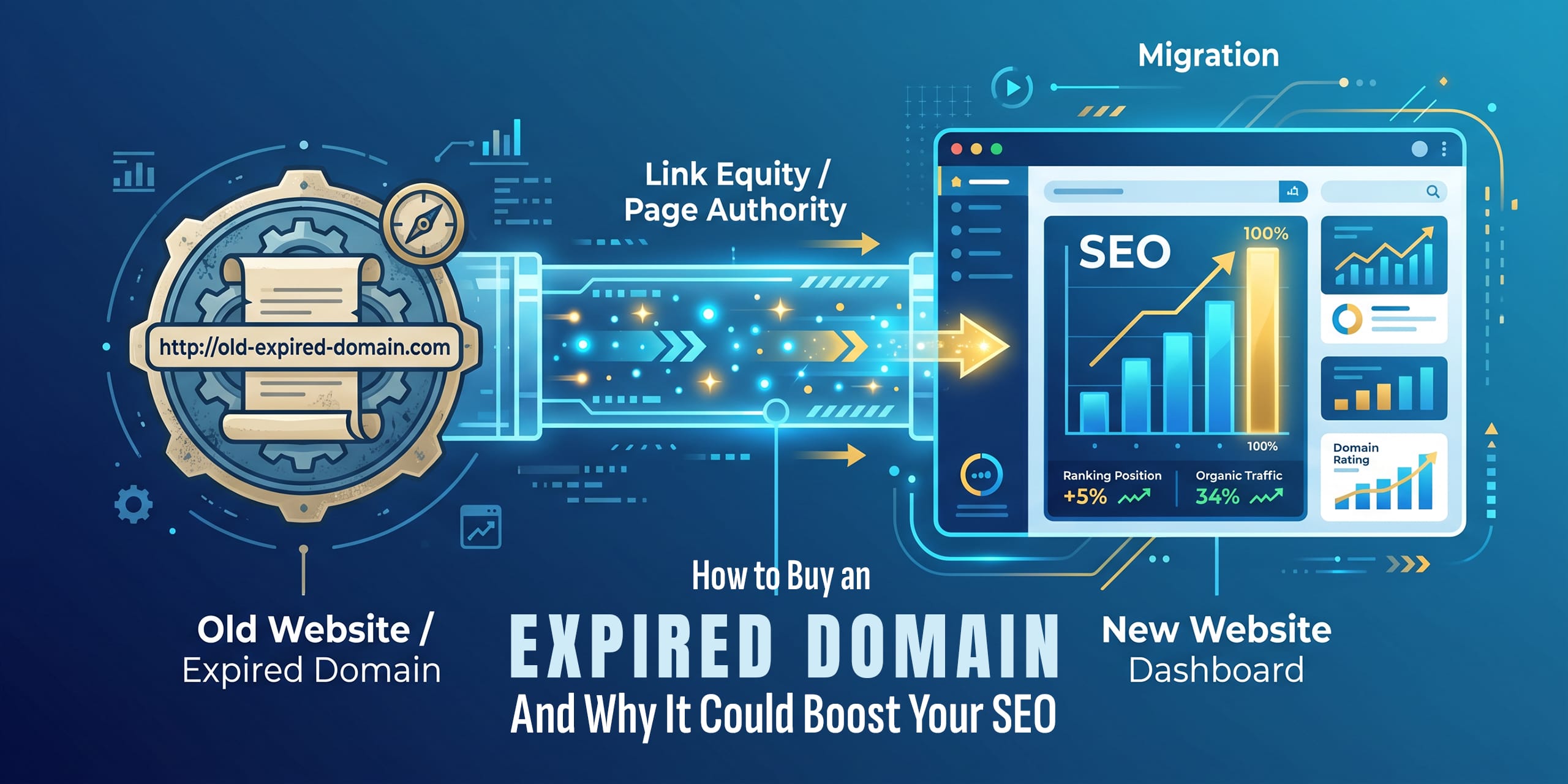
An expired domain is a web address that a previous owner failed to renew. Once it re-enters the public market, it carries all the SEO history that the previous owner built, backlinks from authoritative websites, years of domain age, indexed pages, organic traffic signals, and it can all become yours the moment you register it.
In this guide, you will learn exactly what expired domains are, why they are such a powerful SEO asset, how the domain expiry lifecycle works, what to check before you buy, where to find them, and the step-by-step process to acquire one safely.
What Is an Expired Domain?
A domain name is never truly “owned”; it is rented, typically on a one-to-ten-year basis. When the registration period ends and the owner does not renew it (due to business closure, oversight, or intentional abandonment), the domain enters an expiry cycle that eventually releases it back to the public.
The appeal is straightforward: you inherit the SEO history attached to that domain. This includes backlinks built by the previous owner, domain age recognised by search engines, cached authority, and in some cases, residual organic traffic from old bookmarks and referral links.
Think of it like buying an established business with an existing customer base rather than starting from scratch. A new domain starts with zero authority. An aged domain with a clean history gives your new website a significant head start.
The Domain Expiry Lifecycle: What Happens Step by Step
Understanding the lifecycle is essential to knowing when and how you can acquire an expired domain. Here is exactly what happens after a domain expires:
| Stage | Timeline | What Happens |
| Expiry | Day 0 | Domain registration term ends. Website and email stop working. |
| Grace Period | Days 1–18 to 45* | The owner can still renew at the standard price. The domain is parked or suspended. |
| Redemption Period | Up to 30 days after grace | The owner can recover the domain for a steep fee ($80–$200+). No public access. |
| Auction / Pending Delete | Follows redemption | Registrar lists the domain at auction, or it enters the pending deletion queue. |
| Public Release (The Drop) | 5 days after pending delete | The domain is deleted and becomes available for anyone to register. |
*Grace period varies by registrar: GoDaddy offers 18 days, Namecheap up to 30 days, Cloudflare up to 40 days. Country-code TLDs (.uk, .de, .pk) often have different rules entirely.
Timing tip: The best expired domains are often acquired during auction before the public drop, competition is lower, and SEO value is more predictable.
Why Buying an Expired Domain Can Supercharge Your SEO
Here are the four core SEO advantages that make expired domains so attractive in 2026:
1. Inherited Backlink Equity (Link Juice)
Backlinks remain one of Google’s strongest ranking signals. A new domain starts with zero inbound links. An expired domain may have dozens or hundreds of backlinks from authoritative websites like news outlets, universities, industry blogs, and government portals.
When you acquire that domain and build a website on it, you inherit those trust signals. This is the primary reason SEO professionals seek out expired domains; it can compress months of link-building work into a single acquisition.
2. Established Domain Age and Authority
Search engines treat older domains with more trust than brand-new ones. A domain that has been around for 10 years has a verifiable history. It has been indexed repeatedly, its pages have been crawled, and it has accumulated trust over time.
Domain age alone does not guarantee rankings, but combined with a clean backlink profile and relevant history, an aged domain can rank considerably faster than a brand-new one in competitive niches.
3. Residual Traffic
Many expired domains continue to receive traffic long after the original website goes offline. Old bookmarks, directory listings, forum posts, and referral links all still point to the domain.
When you reactivate the domain with fresh content, this residual traffic can deliver real visitors from day one, before you have even published your first blog post or run your first ad.
4. Accelerated Content Rankings
New domains often spend months in what SEO professionals call the “Google Sandbox”, a period where Google withholds strong rankings from new sites while it evaluates trustworthiness. Expired domains with established history can bypass or significantly shorten this sandbox period, meaning your content starts ranking sooner.
How to Evaluate an Expired Domain Before You Buy
This is the most critical part of the entire process. Not every expired domain is a treasure; some are landmines. A domain with a toxic backlink profile, a Google penalty, or a history of spam can actually hurt your SEO rather than help it.
Here is the exact checklist you should run before committing to any purchase:
Step 1: Check the Domain History in the Wayback Machine
Go to web.archive.org and enter the domain name. Review what the website looked like in the past. You want to see:
- Legitimate content in a relevant niche (not spam, adult content, gambling, or pharmaceuticals unless that is your industry)
- Consistent use over time, not a domain that changed hands repeatedly
- No signs of keyword stuffing, thin content, or link farm activity
Watch Out: If the Wayback Machine shows the site was used for spammy content, link farms, or unrelated niches, walk away regardless of the domain metrics.
Step 2: Analyse the Backlink Profile
Use a professional SEO tool, such as Ahrefs, Semrush, or Moz, to inspect every backlink pointing to the domain. Look for:
- Domain Rating (DR) / Domain Authority (DA): Aim for DR 30+ for meaningful SEO impact. Higher is better.
- Referring domain quality: Links from genuine news sites, industry blogs, and educational domains are gold. Links from link farms are toxic.
- Anchor text distribution: Natural backlink profiles have varied anchor texts. If 80% of anchors are exact-match keywords, that is a red flag for manipulation.
- Trust Flow vs Citation Flow (Majestic): A healthy domain has a relatively balanced ratio between these two metrics.
Watch Out: If a domain has thousands of backlinks but near-zero organic traffic and low domain authority, the links are almost certainly from spam networks. Quality always trumps quantity.
Step 3: Check Google Indexing Status
Search Google for site:domainname.com. If no results appear and the domain previously had active content, it may have received a Google manual penalty or been deindexed for spam.
A deindexed domain is not automatically disqualifying; penalties can sometimes be lifted with a reconsideration request, but it significantly increases risk and recovery time.
Step 4: Run a Spam and Blacklist Check
Use tools like MXToolbox, Spamhaus, and Google Safe Browsing to verify that the domain is not blacklisted. A domain used for phishing, malware distribution, or mass spam emails can be extremely difficult to rehabilitate.
Step 5: Check for Trademark Conflicts
Search trademark databases (USPTO for the US, EUIPO for Europe, IPO for the UK) to ensure the domain name does not infringe on a registered trademark. Acquiring a trademarked domain can result in forced transfer and legal costs regardless of how much you paid.
Step 6: Verify Niche Relevance
The single most overlooked factor in expired domain evaluation: niche alignment.
A domain with a strong backlink profile in the fitness industry will not transfer those SEO benefits to a financial services website. Google’s algorithms understand topical relevance. The expired domain you acquire should align closely with the niche, industry, or subject matter of your intended website.
Where to Find and Buy Expired Domains: Top Marketplaces in 2026
There are several ways to acquire an expired domain, ranging from free public registrations to competitive auctions to private broker deals. Here are the main channels:
| Platform | Model | Best For |
| GoDaddy Auctions | Auction | High-volume marketplace, thousands of listings daily. Competitive but accessible. |
| Namecheap Marketplace | Auction + Buy Now | Affordable options, beginner-friendly interface, and good filtering tools. |
| Sedo | Auction + Brokerage | Premium international marketplace. Strong for .com and European ccTLDs. |
| Afternic | Buy Now + Auction | Wide inventory, integrates with major registrars for instant transfer. |
| ExpiredDomains.net | Free Discovery Tool | Aggregates newly expired and dropping domains daily. Use as a research tool. |
| SnapNames | Auction (Backorder) | Specialises in catching domains at the moment of deletion (the ‘drop’). |
| SEO.domains | Curated Marketplace | Pre-vetted domains with full SEO metrics. Ideal for serious SEO investors. |
| Domain Brokers | Private Negotiation | Best for premium DR 60+ domains that never reach public auctions. |
Auction vs. Backorder vs. Hand-Registration: Which Is Right for You?
- Auction: Competitive bidding on domains still in the expiry cycle. Best for finding quality domains with verified metrics before the public drop.
- Backorder: You instruct a service to register a specific domain the instant it is released. Ideal when you have identified a specific target. Services like SnapNames and NameJet specialise in this.
- Hand-Registration: Manually monitoring and registering a domain after the public drop at the standard registration price. Difficult without automation tools, bots snap up premium drops in milliseconds.
Step-by-Step: How to Buy an Expired Domain
Once you have done your research and identified a target domain, here is the acquisition process from start to finish:
- Define your goal first. Are you launching a new website on the domain? Redirecting it to an existing site to pass link equity? Investing to resell? Your goal determines what metrics matter most.
- Search expired domain marketplaces. Use ExpiredDomains.net or GoDaddy Auctions to filter by DR, domain age, niche, TLD, and price range. Build a shortlist of 5 to 10 candidates.
- Run the full evaluation checklist. Wayback Machine history, backlink audit, Google index check, spam/blacklist check, trademark search, and niche relevance assessment.
- Set your budget and bid strategy. Decide your maximum spend before entering any auction. Domain auctions can trigger emotional bidding, have a hard ceiling, and stick to it.
- Place your bid or backorder. In a live auction, monitor activity closely in the final hours; most bidding happens in the last 24 hours. For a backorder, register your intent with the backorder service well in advance.
- Complete the transfer. Once you win, the domain will be transferred to your registrar account. This can take 24 to 72 hours. Verify DNS settings immediately after transfer.
- Implement your strategy within 30 days. Build your site or set up 301 redirects promptly. An expired domain sitting dormant begins to lose residual traffic and search engine attention.
How to Use an Expired Domain After Buying It
There are three primary strategies for leveraging an expired domain:
Strategy 1: Build a New Website on the Domain
The most common and most valuable use. Register the domain, set up hosting, and build fresh content that aligns with the domain’s previous niche.
Users arriving via old backlinks expect content related to the domain’s history. The closer your content is to the original niche, the better the SEO benefits will carry over. Configure DNS properly, install SSL certificates, set up Google Search Console from day one, and track keyword rankings closely in the first 30 to 60 days.
Strategy 2: 301 Redirect to an Existing Website
If you already have an established website, you can redirect an expired domain’s authority to it via a 301 redirect, signalling to search engines that the content has permanently moved.
A well-implemented 301 redirect can transfer a significant portion of the expired domain’s link equity to your main site. This works best when the expired domain’s niche is closely related to your existing website.
Watch Out: Make sure to map specific old URLs to relevant new pages where possible, not just the homepage. Page-level redirects preserve more link value than blanket domain redirects.
Strategy 3: Domain Flipping (Buy to Resell)
Domain investing, buying expired domains and reselling them at a profit, is a real and active market. Experienced investors acquire aged domains with strong metrics, improve their SEO profile, or simply wait for market demand, then resell through brokerages or marketplaces for multiples of their purchase price.
If this is your goal, focus heavily on brandability alongside SEO metrics: short, memorable names in growing niches command the highest resale premiums.
The Risks of Buying Expired Domains (And How to Avoid Them)
Expired domains are powerful, but they come with real risks if you skip the due diligence. Here is what to watch out for:
| Risk | How to Avoid It |
| Google manual penalty | Check Google Search Console history and use the site: operator to verify indexing. |
| Toxic backlink profile | Run a full Ahrefs/Semrush audit. Disavow toxic links via Google’s Disavow Tool post-purchase if needed. |
| Spam/blacklist history | Run through MXToolbox, Spamhaus, and Google Safe Browsing before buying. |
| Trademark infringement | Search USPTO, EUIPO, or your national IP database before registering or bidding. |
| Niche irrelevance | Match the domain’s historical niche to your intended website topic. |
| Overpaying at auction | Set a hard bid ceiling based on DR, backlink quality, and your intended ROI before bidding. |
| PBN association | Avoid domains that were used in known Private Blog Networks, search for the domain alongside ‘PBN’, and review backlink diversity. |
Frequently Asked Questions
Are expired domains safe to use for SEO?
They can be, if properly vetted. An expired domain with a clean history, natural backlinks, and no penalties is a legitimate and powerful SEO asset. The risk comes from skipping due diligence and buying a domain with hidden penalties or spam history.
How much do expired domains cost?
Prices range enormously. Basic expired domains with modest authority can be acquired for $10 to $200 at auction. Mid-tier domains with strong DR and clean backlink profiles typically sell for $500 to $5,000. Premium domains with DR 60+ and authoritative backlinks can fetch $10,000 to $100,000+.
What is the difference between an expired domain and a dropped domain?
An expired domain is any domain past its renewal date. A dropped domain specifically refers to one that has completed the full expiry lifecycle, grace period, redemption, and pending delete, and has been permanently released back to the public registry for open registration.
Can I redirect an expired domain to my existing website for SEO benefits?
Yes, via a 301 redirect. This can pass a meaningful portion of the expired domain’s link equity to your main site. The benefit is strongest when the expired domain’s niche is topically related to your destination website.
How long does it take to see SEO results from an expired domain?
If building a new website on the domain, many marketers report faster-than-normal ranking times, sometimes seeing traction in 4 to 8 weeks rather than the 6 to 12 months typical for brand-new domains. Results vary significantly based on domain quality, content strategy, and niche competitiveness.
What tools do I need to evaluate an expired domain?
The essential toolkit: Ahrefs or Semrush (backlink analysis), Majestic (Trust Flow / Citation Flow), the Wayback Machine (history check), MXToolbox (spam/blacklist), Google Search (index check), and your national trademark database (IP conflicts). Most serious buyers use at least three of these before committing.
Final Thoughts
For SEO professionals, content marketers, and digital entrepreneurs, yes, absolutely. A well-chosen expired domain is one of the fastest paths to building online authority that would otherwise take years of consistent link-building to achieve organically.
The keyword is “well-chosen.” Skipping due diligence and buying a domain with a toxic history or Google penalty can set your SEO back rather than forward. The evaluation process described in this guide is not optional; it is the entire difference between a smart investment and a costly mistake.
Do the research. Run the checklist. Set a clear budget. And when you find a clean domain with strong authority in your niche, move quickly. Good expired domains do not stay available for long.
Looking to secure a great domain for your next project?
Browse available domain names, new, premium, and aftermarket, at HashedDomains.com and find your perfect match today.