In this guide, we will explain exactly what a brand TLD is, how global giants are using them right now, what the 2026 ICANN application window means for your brand, and, most importantly, whether your business should seriously consider registering one.
What is a Brand TLD (dotBrand)?
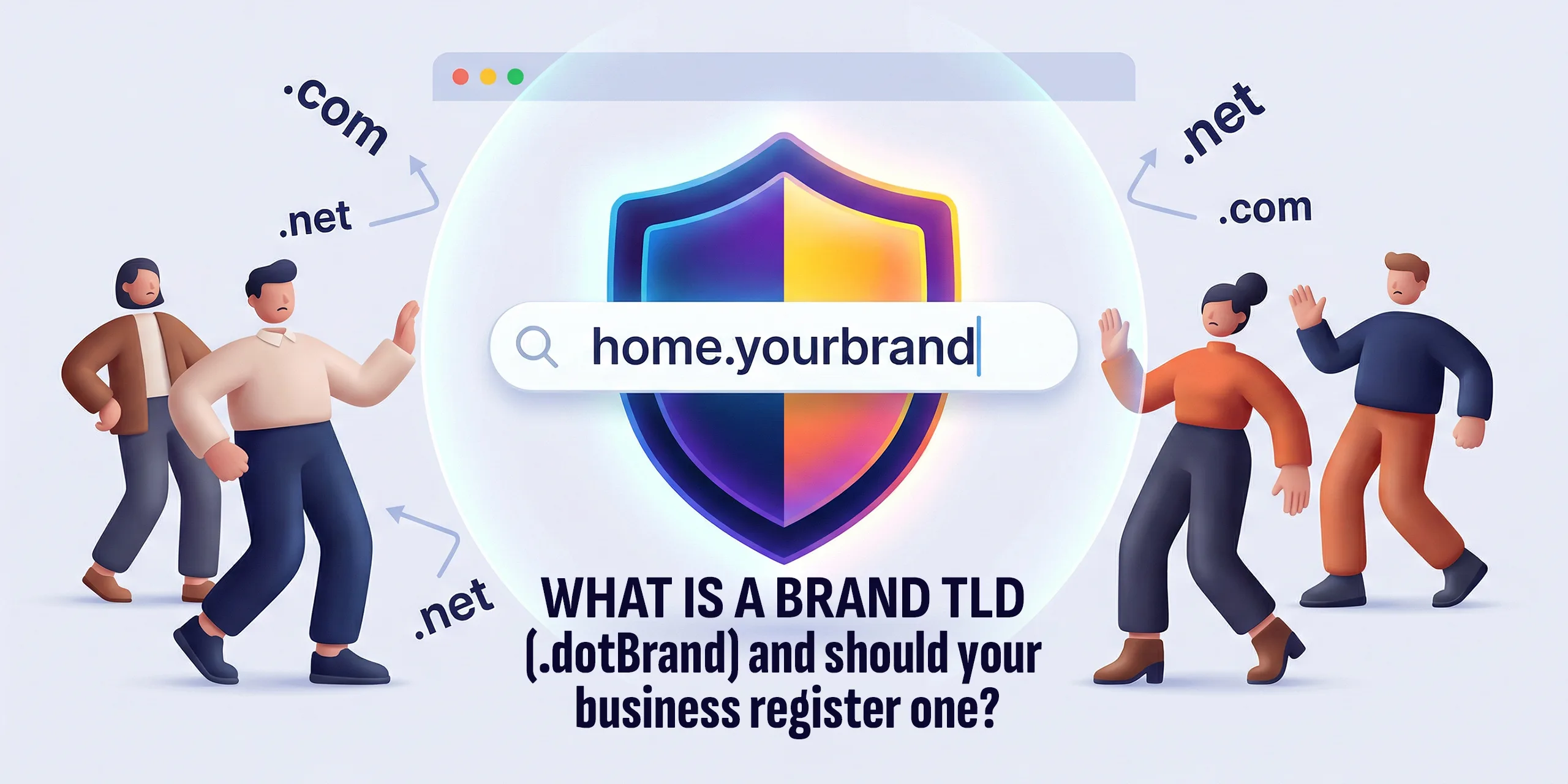
A brand TLD (also called a dotBrand, dotBrand gTLD, or custom TLD) is a top-level domain where your company name itself becomes the domain extension, the part of the URL that sits to the right of the final dot.
In a conventional domain like hashedomains.com, the TLD is .com, a shared, open extension anyone can register under. In a dotBrand model, a company like HashedDomains would own .hashedomains entirely. Nobody else could register a domain ending in .hashedomains. Every address in that namespace, blog.hashedomains, support.hashedomains, careers.hashedomains, would belong exclusively to the brand.
The concept is defined under what ICANN calls Specification 13 of its Registry Agreement. To qualify as a dotBrand TLD, three conditions must be met:
- The TLD string must match a registered trademark owned by the applicant.
- Only the brand owner, its affiliates, or licensed partners can register domains under the TLD.
- The TLD cannot be a generic string; it must be a proper brand name.
In short, a dotBrand is your own private namespace on the global internet. You set the rules. You control every address. No squatters, no copycats, no confusion.
Also Read: How to Choose the Perfect Domain Name
How Real Brands Are Using Their dotBrand TLDs Right Now
DotBrand TLDs are not theoretical. Since the first ICANN application round in 2012, some of the world’s most recognizable companies have been quietly building out their custom namespaces. Here is how they are using them:
Google (.google)
Google operates an extensive dotBrand strategy across its product portfolio. Domains like domains.google, ai.google, wallet.google, and about.google cluster services under a single trusted namespace, making it clear to any user that they are interacting with a genuine Google property, not a third-party site.
BMW (.bmw)
BMW uses its dotBrand TLD for both regional campaigns and product-specific microsites. Short, memorable URLs like drive.bmw and summerschool.bmw eliminate the need for long, cluttered .com paths and create a cleaner experience for global audiences who might otherwise be confused by country-code domain differences.
Barclays (.barclays and .barclaycard)
Barclays Bank migrated its primary corporate website to home.barclays, using the dotBrand as the main entry point for global customers while keeping country-specific URLs like barclays.co.uk for local services. The primary motivation was anti-phishing protection; a domain that nobody else can register under is a domain nobody can spoof.
Microsoft (.microsoft)
Microsoft uses home.microsoft and cloud.microsoft to direct users to key products. The clear, authoritative URLs reinforce brand credibility and provide unambiguous trust signals to users who have been trained to distrust lookalike phishing domains.
Canon (.canon)
Canon centralizes its global corporate presence at global.canon, replacing a fragmented network of regional domains with a single, brand-centric hub that works consistently for international audiences.
What these examples share is a common thread: the dotBrand is used not primarily as a consumer-facing website, but as an infrastructure layer for identity, trust, and operational control.
Also Read: How to Fix “NET::ERR_CERT_COMMON_NAME_INVALID” Error
The 4 Core Benefits of Owning a Brand TLD
1. Unbreakable Brand Protection
In the world of traditional domains, brand protection is an endless game of whack-a-mole. You register yourbrand.com, then yourbrand.net, then yourbrand.co, then yourbrand.store, and you still cannot stop a determined bad actor from registering yourbrandofficial.com or yourbrand-support.net.
A dotBrand eliminates this problem by design. When you own .yourbrand, no external party can register any domain under that extension. The cybersquatter cannot register fake.yourbrand. The phisher cannot create login.yourbrand. The namespace is entirely closed.
Key insight: Instead of paying for hundreds of defensive registrations across dozens of TLDs every year, a single dotBrand secures your entire namespace permanently.
2. Enhanced Security and Anti-Phishing
Phishing attacks overwhelmingly rely on confusingly similar domains, yourbank-secure.com, login-yourbank.net, yourbank.support. These attacks are effective precisely because users cannot easily tell a fake domain from a real one.
A dotBrand changes the trust equation entirely. Users can be trained to recognize one simple rule: if it ends in .yourbrand, it is genuinely yours. No imitation is possible. This is why financial institutions like Barclays have been among the most enthusiastic dotBrand adopters. In banking, a single phishing attack that erodes customer trust is worth far more than the cost of a dotBrand application.
3. Marketing Flexibility and Memorable URLs
Traditional domain structures force long, forgettable URLs: yourbrand.com/campaigns/summer-2026/landing-page-1. A dotBrand enables cleaner, more memorable campaign addresses: summer.yourbrand. The same logic applies to product pages, regional sites, job listings, investor portals, and customer support hubs.
Sky, the British media group, was among the first to embrace this approach, using .sky for campaign microsites and product redirects, creating shorter calls to action in advertising that were easier for audiences to type and remember.
4. Operational and Governance Control
Enterprises managing complex product portfolios, global markets, and multiple business units face a constant challenge: coordinating domain governance across dozens of registrars, hundreds of domains, and numerous DNS providers.
A dotBrand collapses this complexity. With a single TLD under your control, you manage all DNS records, security policies, and naming conventions from one place. You can enforce HTTPS across your entire namespace, implement DNSSEC universally, and create clear internal naming standards without fighting availability conflicts on public registries.
Also Read: HTTP Error 431
The 2026 ICANN Application Window: A Once-in-a-Decade Opportunity
Here is the critical context: dotBrand TLDs are not available for purchase like regular domain names. They require a formal application to ICANN, the Internet Corporation for Assigned Names and Numbers, the global body that oversees the domain name system.
The last time applications were accepted was in 2012. Over 600 brands applied in that round, including Google, Microsoft, Apple, Amazon, Barclays, BMW, Nike, and Walmart. After that window closed, no further rounds were opened for over a decade.
The next window opens on April 30, 2026, and will remain open for approximately 12 to 15 weeks. After it closes, the next opportunity may be another decade away. ICANN has made no commitments to a regular future schedule.
Key Dates and Numbers
| Detail | Information | Notes |
|---|---|---|
| Application Window Opens | April 30, 2026 | Time-sensitive, act now |
| Window Duration | 12 to 15 weeks | Closes approx. July–August 2026 |
| ICANN Application Fee | $227,000 USD | Non-refundable evaluation fee |
| dotBrand Evaluation Fee | $500 USD additional | On top of the base application fee |
| Trademark Required? | Yes | Must own a registered trademark matching the TLD string |
| Earliest Activation | 2027 at the earliest | Based on the 2012 round timeline of 18+ months |
| Next Expected Round | Unknown, potentially 2030s | ICANN has not committed to a schedule |
What You Need to Apply
To be eligible for a dotBrand TLD application in 2026, your organization must:
- Own a registered trademark in the TLD string you are applying for, in at least one jurisdiction.
- Demonstrate financial capacity to operate a registry (ongoing infrastructure, legal, and operational costs).
- Appoint or contract with an ICANN-accredited Registry Service Provider (RSP) for technical operations.
- Complete ICANN’s full application and pay the evaluation fee of $227,000 USD.
- Pass ICANN’s technical, financial, and legal evaluation process.
Planning note: Many brands that applied in 2012 started preparation 12 to 18 months before the window opened. If you are considering applying in 2026, begin consultations with an RSP and legal counsel immediately.
Should Your Business Register a Brand TLD?
This is where honest advice matters. A dotBrand TLD is one of the most powerful digital assets a brand can own, but it is also one of the most expensive and complex. It is not right for every business.
Here is a clear-eyed framework for deciding:
dotBrand Is Likely Right for You If…
- You are a global or national brand with high customer trust requirements (banking, healthcare, finance, consumer goods, tech).
- Your brand faces ongoing phishing, impersonation, or domain abuse that costs real money in enforcement and customer trust.
- You have a complex digital footprint, multiple products, regions, or campaigns that could benefit from a unified namespace.
- You have registered trademarks and the legal infrastructure to support an IP-intensive application process.
- You have the budget: $227,000 application fee plus ongoing annual costs of $50,000-$250,000+ for registry operations.
- Your organization thinks in 10-year digital strategy horizons, not 12-month marketing cycles.
dotBrand May NOT Be Right for You If…
- You are a small or medium-sized business without significant brand protection concerns.
- Your budget for all digital infrastructure is less than six figures.
- Your business is relatively young, or the brand name could change.
- You are not prepared for a multi-year implementation timeline before seeing operational benefits.
- You do not own a registered trademark in your desired TLD string.
Bottom line: If you run a global brand with a six-figure marketing budget, strong trademark portfolio, and long-term digital ambitions, a dotBrand is worth serious consideration right now. If you are a startup or SME, focus on a strong .com or modern TLD strategy first.
Also Read: Connect Your Domain to WordPress, Wix, or Shopify
What About Small and Medium Businesses?
If you are reading this and thinking, “this clearly is not for me,” you are probably right about the dotBrand application itself. But the 2026 ICANN round has important implications for smaller brands, too.
New Generic TLDs Are Also Opening
The 2026 application round is not just for dotBrands. It also includes applications for new generic TLDs, extensions like .shop, .tech, .ai, .club, and industry-specific options. As new TLDs emerge from this round over the next few years, new branding and registration opportunities will open up for businesses of all sizes.
Protect Your Brand Against New TLDs
When new TLDs launch, brand owners need to defensively register their names under those extensions quickly, before cybersquatters do. The 2026 round will eventually produce hundreds of new extensions, each representing a potential gap in your brand protection strategy.
Even if you are not applying for a dotBrand, this is the right time to:
- Audit your current domain portfolio for gaps.
- Set up monitoring alerts for new TLD launches.
- Register your brand name under any new commercially relevant TLDs as soon as they become available.
dotBrand vs. Traditional Domain: Side-by-Side Comparison
| Feature | Traditional Domain (.com) | dotBrand TLD (.brand) |
|---|---|---|
| Who can register? | Anyone | Brand owner only |
| Brand protection | Reactive, monitor, and enforce | Preventive, namespace is closed |
| Anti-phishing | Partial, lookalikes still possible | Complete, no external registrations |
| Typical cost | $10-$50/year per domain | $227,000 application + ongoing fees |
| URL structure | yourbrand.com/page | page.yourbrand |
| DNS control | Via registrar | Full self-governance |
| Availability | Widely available | ICANN application required |
| Consumer recognition | Universal | Growing, still building awareness |
| Best for | All businesses | Global brands, enterprises |
How to Apply for a Brand TLD in 2026: Key Steps
If you have decided a dotBrand application makes sense for your organization, here is a high-level roadmap for the April 2026 window:
- Confirm trademark eligibility: Verify you own a registered trademark matching your desired TLD string in at least one jurisdiction.
- Select a Registry Service Provider (RSP): You must partner with an ICANN-accredited technical operator to run your TLD infrastructure. This choice should be made well before the window opens.
- Secure budget approval: The ICANN fee alone is $227,000 USD. Factor in legal fees, consulting costs, RSP contracts, and 2-3 years of operational runway.
- Build your application: ICANN’s Applicant Guidebook outlines the full requirements. Prepare detailed responses covering technical, financial, and operational criteria.
- Submit before the window closes: The window is 12 to 15 weeks. Late submissions are not accepted.
- Navigate evaluation and delegation: Expect 12 to 24 months from submission to activation, based on 2012 round timelines.
- Plan your launch and rollout: Define your naming policy, internal governance framework, and consumer education strategy before going live.
Frequently Asked Questions
What is the difference between a dotBrand and a regular domain?
A regular domain (like yourbrand.com) is a second-level domain registered under a shared extension open to everyone. A dotBrand TLD means your brand name is itself the top-level extension, and only you control every domain registered under it.
How much does a brand TLD cost?
The ICANN application fee is $227,000 USD, plus ongoing annual costs for registry operations, legal compliance, and RSP services, typically ranging from $50,000 to $250,000+ per year depending on scale and usage.
Do I need a trademark to apply for a dotBrand?
Yes. You must own a registered trademark matching the TLD string you are applying for, in at least one jurisdiction recognized under international IP law.
Will a dotBrand TLD help with SEO?
DotBrand TLDs are treated equally by search engines. Google itself uses domains.google and ai.google, which rank highly in search results. The SEO impact depends on how well the domain is used, not on the TLD format itself.
When is the next dotBrand application window after 2026?
ICANN has not committed to a schedule for future rounds. Based on the gap between the 2012 round and the 2026 round, the next opportunity may not arrive until the early to mid-2030s. The 2026 window is the only realistic near-term opportunity for most brands.
Can a small business apply for a dotBrand TLD?
Technically, yes, if the business owns an eligible trademark. In practice, the $227,000 application fee and ongoing operational costs make dotBrand TLDs suitable primarily for established enterprises with significant brand protection and digital infrastructure needs.
Final Verdict: Is a dotBrand Worth It?
For large, established brands that take their digital identity seriously, yes, absolutely. A dotBrand TLD is not just a URL. It is a statement that your organization owns its corner of the internet, takes brand security seriously, and is building for the long term.
The 2026 window is genuinely rare. If the last round is any guide, the next opportunity may not come until the mid-2030s. For brands with the means and the vision, the time to act is right now, before the April 30 window opens.
For everyone else: stay informed, protect your brand under emerging TLDs as they launch, and build a strong domain portfolio on the extensions that matter for your market today.
Need help protecting your brand’s domain portfolio?
Whether you are monitoring new TLD launches, registering defensive domains, or building a full brand protection strategy, HashedDomains.com has you covered. Search and register your domains today.