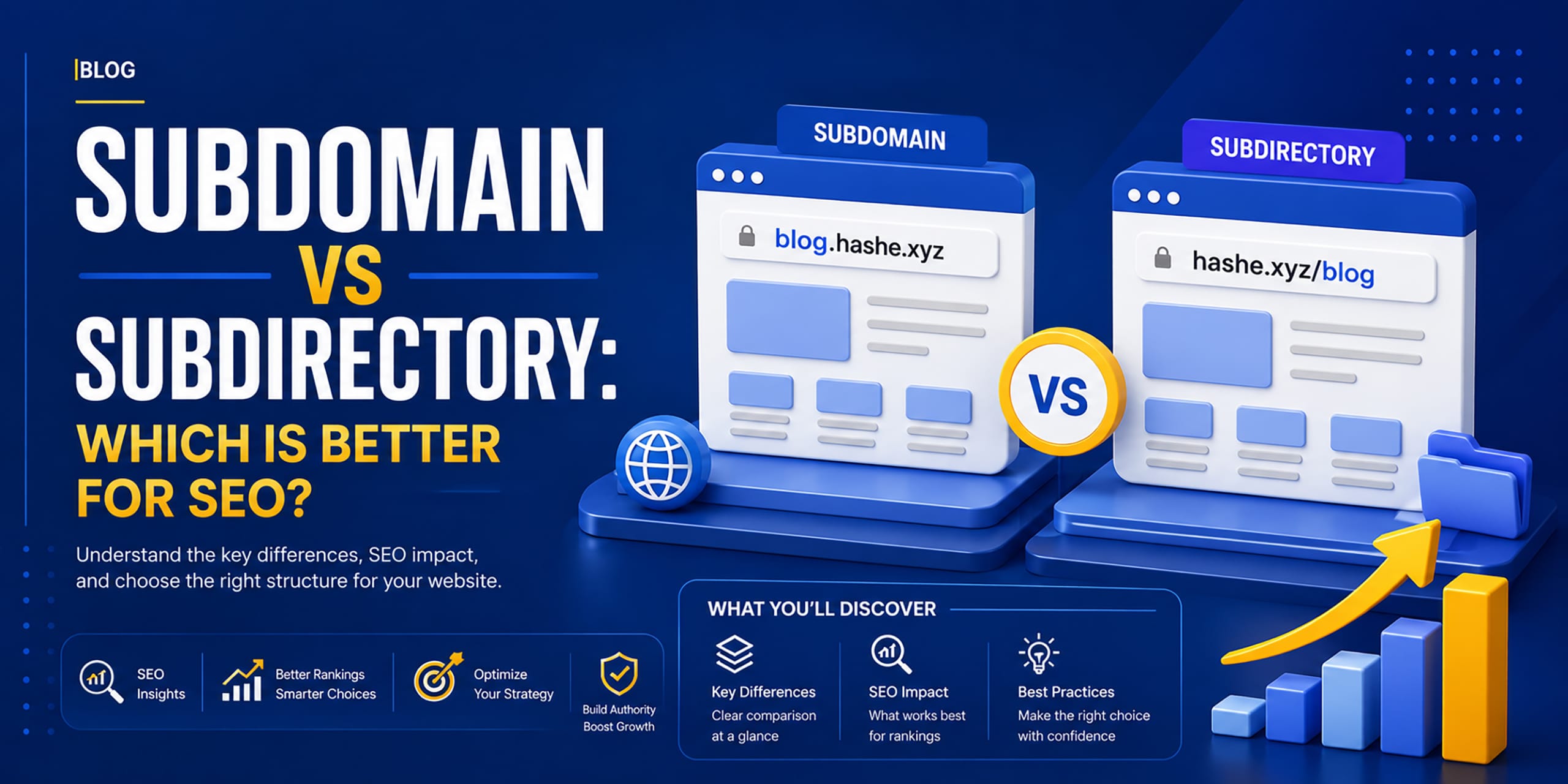
If you have ever registered a domain and started planning your website structure, one question comes up almost immediately: should your blog, shop, or support section live at blog.hashedomains.com or hashedomains.com/blog?
It sounds like a technical detail. In reality, it is one of the most consequential structural decisions you can make for your long-term SEO performance.
At HashedDomains, we work with domain owners every day, and this question comes up constantly. In this guide, we will explain exactly how Google treats each structure in 2026, share what the data shows, and give you a clear recommendation based on your specific situation.
What Is the Difference Between a Subdomain and a Subdirectory?
Before we look at SEO impact, it is worth being precise about what these terms actually mean.
What is a subdomain?
A subdomain sits in front of your root domain, separated by a dot. It is technically a separate hostname.
Examples:
- blog.hashedomains.com
- shop.hashedomains.com
- support.hashedomains.com
From a DNS and server perspective, a subdomain can be hosted on an entirely different server, run a completely different platform, and have no technical relationship to the main domain at all. This flexibility is both its strength and its SEO weakness.
What is a subdirectory (subfolder)?
A subdirectory is a folder path within your root domain, separated by a forward slash.
Examples:
- hashedomains.com/blog
- hashedomains.com/shop
- hashedomains.com/support
A subdirectory is always part of the same website, the same server, and the same domain in the eyes of both search engines and users.
How Google Actually Treats Subdomains vs Subdirectories
Google has repeatedly clarified that it can understand both subdomains and subdirectories and is generally able to associate them with the same website when needed. However, from an SEO perspective, the way signals are processed is not always equally efficient across both structures.
In practice, Google treats both structures as valid, but subdirectories tend to provide a cleaner and more direct consolidation of SEO signals under a single domain.
A subdirectory (such as hashedomains.com/blog) is naturally interpreted as part of the main website. This makes it easier for Google to combine signals like backlinks, internal links, and topical relevance into one unified authority profile for the domain.
Subdomains (such as blog.hashedomains.com), on the other hand, are still connected to the root domain but may be processed with a higher degree of separation. While Google can eventually associate them with the main site, they are often treated with more independence, especially during early indexing and ranking phases.
Because of this structure, subdirectories usually allow faster and more straightforward authority consolidation, which is why they are commonly preferred for SEO-focused content strategies.
In short, Google supports both approaches, but subdirectories make it easier for search engines to understand the site as one cohesive entity.
The Real SEO Impact: What Changes With Each Structure
Authority flow
Domain authority, the cumulative trust and link equity built up over time, flows freely within a subdirectory structure. Every piece of content at hashedomains.com/blog benefits from every backlink that points to hashedomains.com and vice versa.
With a subdomain, this flow is weaker. A link to blog.hashedomains.com contributes primarily to that subdomain’s authority, not automatically to hashedomains.com. If your main domain is strong but your subdomain is new, your blog articles start from a weaker baseline than they need to.
Internal linking
Internal linking is one of the most powerful (and underused) SEO levers available. When your blog lives at hashedomains.com/blog, a link from a blog post to a service page at hashedomains.com/domain-search passes PageRank across the same domain, clean and effective.
When your blog is at blog.hashedomains.com, cross-linking to hashedomains.com is technically an external link from Google’s perspective in some interpretations, and at best a weaker signal than same-domain linking. This matters when you are trying to rank service pages using the authority built by your content.
Topical authority and content clustering
Google’s 2026 ranking systems place enormous emphasis on topical authority, the idea that a domain (or subdomain) that covers a topic deeply and consistently is more trustworthy than one with scattered, surface-level content.
Building topical authority is far easier when your content is housed in one place. A subdirectory structure allows your blog posts, landing pages, resource guides, and tool pages to reinforce each other as a single coherent cluster under hashedomains.com.
Crawl budget
For smaller and medium-sized sites, crawl budget is rarely a critical concern. But for larger sites with thousands of pages, Google allocates a crawl budget per domain. Splitting content across a subdomain creates two separate crawl budgets to manage, which can result in important pages being crawled less frequently.
Pros and Cons: Subdomain
Where subdomains genuinely help
Separate technology stacks. If your main site runs on a static CMS but you are launching a SaaS product that requires a full web application, running app.hashedomains.com on its own infrastructure makes practical sense, and the SEO tradeoff is worth the technical necessity.
Distinct audiences. If hashedomains.com serves individual domain buyers but enterprise.hashedomains.com serves large organisations with entirely different needs, a subdomain can help you serve those audiences with different design, messaging, and content without confusing either group.
Multilingual sites at scale. Large international operations sometimes use subdomains per region (fr.hashedomains.com, de.hashedomains.com) with dedicated hosting per region. For these cases, the operational benefits often outweigh the SEO considerations.
Isolated risk. If a subdomain is hit by a manual penalty or algorithmic demotion, it is less likely to drag the main domain down with it, though this is a double-edged sword, since a penalised main domain also has less impact on your subdomain.
Where subdomains hurt
- Backlinks earned by blog content do not fully flow to the main domain’s authority pool
- New subdomains require their own authority-building from scratch, even on established root domains
- Internal linking between the subdomain and the main domain is less SEO-efficient.
- Separate XML sitemaps, Search Console properties, and analytics segments add management overhead.
- Content on a subdomain does not reinforce the topical signals on the main domain as effectively.
Pros and Cons: Subdirectory
Where subdirectories excel
Full authority consolidation. Every word of content, every backlink, every positive user signal contributes to one domain. This is the single biggest structural advantage in modern SEO.
Stronger internal linking. Blog posts can pass PageRank directly to service pages, tool pages, and product listings without any structural friction.
Simpler SEO management. One Search Console property, one sitemap, one analytics domain, one set of rankings to monitor.
Faster ranking velocity. Content published at hashedomains.com/blog immediately benefits from whatever authority the root domain has already earned. A new post does not start from zero.
Better content clustering. Related topics can be grouped (hashedomains.com/blog/domain-extensions/, hashedomains.com/blog/domain-investment/) in ways that signal topical depth to Google.
Where subdirectories are less suited
Cross-platform technical complexity. If your blog runs on WordPress but your main site runs on a custom framework, housing both under the same domain requires reverse proxy configuration or other engineering solutions. It is achievable; many large sites do it, but it adds complexity.
Shared risk. A technical issue on one part of the site (excessive crawl errors, accidental noindex, server downtime) can affect the whole domain more directly.
Less isolation between sections. For very large enterprise sites with genuinely separate business units, a single domain can become unwieldy to manage and optimise.
The 2026 Verdict: Which Should You Choose?
For the vast majority of websites, including content-driven sites, agency blogs, SaaS marketing sites, e-commerce brands, and local businesses, subdirectories are the stronger SEO choice in 2026.
The directional trend in Google’s algorithm over recent years has been toward rewarding consolidated topical authority, strong internal link structures, and consistent domain-level trust signals. All three of these favour the subdirectory model.
Use a subdirectory for:
- Your blog or content hub
- Service pages and landing pages
- Resource centres and knowledge bases
- Case studies and portfolio sections
- FAQ and glossary pages
Use a subdomain for:
- Separate web applications (app.hashedomains.com)
- Customer support portals with different software (support.hashedomains.com)
- Genuinely distinct products targeting different audiences
- Development or staging environments (staging.hashedomains.com)
- Regional sites, when dedicated local hosting is required
The Blog Question: Subdomain or Subdirectory?
This is the most common question in this debate, and the answer is simple from an SEO perspective: use a subdirectory for your blog.
For example, if HashedDomains publishes content on domain valuation, extensions, and naming strategies, the ideal structure would be:
- hashedomains.com/blog/how-to-value-a-domain
- hashedomains.com/blog/best-domain-extensions-2026
- hashedomains.com/blog/how-to-choose-a-domain-name
In this structure, every blog post strengthens the same domain authority. That means the content not only ranks on its own but also supports important pages like:
- hashedomains.com/domain-search
- hashedomains.com/pricing
If the same content is placed on a subdomain like blog.hashedomains.com, it may still rank, but the authority is often partially isolated. This reduces how effectively your content supports your main commercial pages.
For platforms like HashedDomains, where trust, authority, and organic visibility are core business goals, keeping the blog under the main domain is not just an SEO preference; it is a strategic advantage for long-term growth.
Multilingual SEO: Subdomain or Subdirectory?
If HashedDomains expands into multiple languages, such as French, Spanish, or German, choosing the right URL structure becomes important for SEO and scalability.
Both subdomains and subdirectories are supported by Google and work with hreflang tags, but they distribute SEO authority differently.
Subdirectory approach
- hashedomains.com/fr/
- hashedomains.com/es/
- hashedomains.com/de/
This structure keeps all language versions under one domain, helping consolidate authority and improve overall SEO strength. It is also easier to manage and is generally preferred for small to mid-sized businesses focused on organic growth.
Subdomain approach
- fr.hashedomains.com
- es.hashedomains.com
- de.hashedomains.com
This setup offers more flexibility for regional hosting, customization, and localization. However, each subdomain must build its own SEO authority separately, which can slow down ranking performance.
SEO recommendation
For most websites, including HashedDomains, a subdirectory structure is the better choice for multilingual SEO unless there is a strong technical or operational reason to use subdomains.
How to Migrate from a Subdomain to a Subdirectory
If your blog or content section is already on a subdomain and you want to move it, the migration is manageable, but it needs to be done carefully to avoid losing rankings during the transition.
Step-by-step migration process
- Audit your current subdomain content. Identify all indexed URLs on blog.hashedomains.com using Google Search Console or a crawl tool. Export the full list.
- Set up the new subdirectory structure. Create the target URL structure at hashedomains.com/blog/ before moving any content. Ensure the new URLs are logical and consistent.
- Implement 301 redirects. Every old URL on blog.hashedomains.com must have a permanent (301) redirect pointing to its equivalent URL at hashedomains.com/blog/. This transfers link equity and tells Google the content has permanently moved.
Example: blog.hashedomains.com/domain-valuation → hashedomains.com/blog/domain-valuation
- Update your XML sitemap. Generate a new sitemap reflecting the subdirectory URLs and submit it via Google Search Console.
- Update Google Search Console. Add hashedomains.com/blog as a URL prefix property if you were tracking blog.hashedomains.com separately. Monitor for crawl errors in the weeks following migration.
- Update all internal links. Replace every internal link on your site that points to blog.hashedomains.com with the new hashedomains.com/blog equivalent. Do not rely on redirects for internal links; update them directly.
- Monitor rankings for 60-90 days. Some temporary ranking fluctuation is normal after a migration. Rankings typically recover and often improve within 3 months as Google processes the consolidated structure.
Best Practices for Site Structure in 2026
Whichever structure you use, these fundamentals apply across the board:
Keep URL structures clean and predictable. Avoid long chains of subfolders. Most content should sit no more than three levels deep: hashedomains.com/blog/domain-extensions/new-tlds/ is about as deep as you want to go.
Group related content deliberately. Use subdirectory structures to signal topic clusters. A folder like /domain-investing/ that contains multiple related articles tells Google this domain has genuine depth on that topic.
Build internal links with purpose. Every time you publish a new piece of content, link it to related existing content and to relevant service pages. This is how blog content creates commercial value, not just traffic.
Use descriptive, keyword-informed URLs. hashedomains.com/blog/how-to-buy-an-expired-domain is better than hashedomains.com/blog/post-1473.
Never split authority unnecessarily. If there is no compelling technical or operational reason to use a subdomain, default to the subdirectory. The SEO cost of unnecessary subdomain use compounds over time.
FAQs
Is a subdomain bad for SEO?
Not inherently. A subdomain is not harmful to SEO, but it often does not consolidate authority as effectively as a subdirectory. In most cases, subdirectories are preferred because they allow content to directly strengthen the main domain’s ranking potential.
Do subdomains rank separately on Google?
Yes, they can. Google may treat subdomains as partially separate entities, depending on how they are structured and linked. This means a subdomain may build its own authority independently, instead of fully benefiting from the main domain’s backlink profile.
Should I use a blog on a subdomain or subdirectory?
For most SEO-focused websites, a subdirectory is the better choice. Using hashedomains.com/blog helps consolidate authority, improve internal linking strength, and support faster ranking growth compared to blog.hashedomains.com.
Summary
The subdomain vs subdirectory debate has a clear answer for most sites in 2026: subdirectories are structurally stronger for SEO in the majority of use cases.
They consolidate domain authority, strengthen internal linking, support content clustering, and give your content the best possible starting position in Google’s rankings. For HashedDomains, a platform where trust, topical expertise, and organic visibility are core to the business, a subdirectory-first approach to site structure is not just the SEO recommendation. It is the right strategic foundation.
Use subdomains when you have a genuine technical or operational reason to do so. For everything else, keep it under one roof.