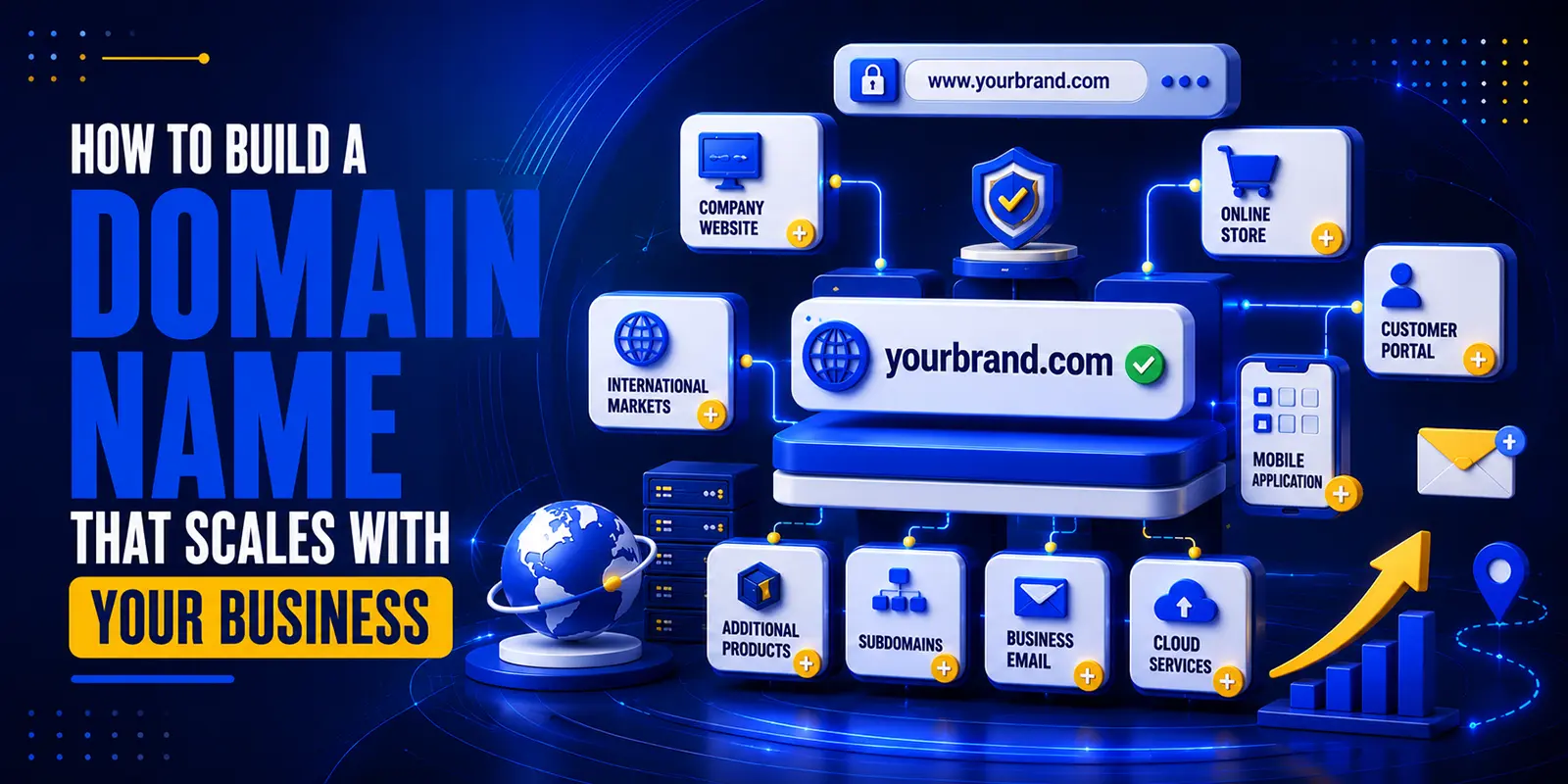
You have a startup idea. It is focused, specific, and solves a real problem. So you choose a domain name that describes exactly what you do.
Two years later, you are trying to expand into adjacent markets, raise a Series A, or attract enterprise clients, and your domain name is quietly working against you at every step.
This is one of the most common and most painful mistakes in startup branding. A domain that felt perfect at launch becomes a constraint as the business grows. And by the time founders realise it, fixing it is expensive: SEO authority lost, backlinks redirected, brand assets reprinted, customer expectations reset.
Analysis of over 5,000 startup domain purchases found a clear pattern: the most successful brand names are flexible, evocative, and industry-agnostic, not literal descriptions of what the product does today. Notion does not say “notes.” Figma does not say “design.” Stripe does not say “payments.” All of them could pivot, expand, and grow without their name becoming a liability.
In this guide, we will walk through the eight most common startup domain naming mistakes that create scalability problems, the framework for choosing a name that genuinely grows with your business, and the real-world lessons from startups that got it wrong and the expensive rebrands that followed.
Why Domain Name Scalability Matters More Than Ever in 2026
There are currently 378.5 million domain names registered worldwide, a figure that grows by millions each quarter. The result: the most desirable short, memorable .com domain names are almost entirely gone.
This scarcity creates a trap. Founders who cannot find their ideal short brandable .com domain often compensate by adding specificity, a product descriptor, a city name, a year, or a niche qualifier. The domain becomes available. The decision feels practical. But the specificity that solves an availability problem in 2026 creates a scalability problem in 2028.
A Forbes analysis of over 5,000 recent startup domain purchases found a clear and consistent trend: founders today lean heavily into names that feel open-ended, ones that spark curiosity or emotion instead of simply describing a function. The data shows a rise in short, brandable names that are phonetically smooth and emotionally resonant, but not directly descriptive of the product.
The market is telling you something. The startups acquiring and building on the most valuable domain names in 2026 are choosing flexibility over description and brand over keyword. Here is how to make the same choice for your business.
The 8 Startup Domain Naming Mistakes That Kill Scalability
Mistake 1: The Overly Specific Product Domain
This is the most common mistake: choosing a domain that describes exactly what your product does today, with no room for what it might become.
Imagine launching invoicegeneratorpro.com. It makes sense; you are building an invoice generator. But twelve months in, you add expense tracking, then payroll, then financial reporting. Your domain now describes one feature of a much larger product. You either live with a name that undersells the business, or you rebrand and absorb all the costs that come with it.
Watch Out: Startups that choose hyper-specific product domains are most likely to rebrand after Series A, a process that affects SEO rankings, brand assets, customer recognition, and email infrastructure simultaneously.
The fix: Choose a name at the category level, not the feature level. Not “invoicegenerator”, but something that could represent a full financial management platform. Not “chatwidget”, but something that could scale to represent a complete customer communication suite.
Mistake 2: The Location-Locked Domain
Adding a city, region, or country to your domain name solves an availability problem and feels like a good local SEO strategy. It is neither. It is a scalability trap.
Domains like manchesterphotographystudio.com, dubaiwebagency.ae, or lahoredeliveryapp.com lock your brand to a geography before you know where your business will go. Even if you never intend to expand internationally, your location-branded domain creates immediate ceiling problems:
- Customers in adjacent cities may perceive your services as unavailable to them
- Investors and enterprise clients interpret location domains as small, local operations
- If you expand or relocate, your domain actively works against your new positioning
- The domain holds negligible resale value compared to a clean, brandable name
Real Example: A yoga studio that launched as londonhotyoga.com expanded to online classes during 2020. The domain continued to mislead prospective students outside London for years after the business went fully digital.
Mistake 3: The Year-Stamped Domain
Domains with years in them, agency2024.com, techsummit2026.com, marketingguide2025.com, start outdated the moment the year changes. They are relevant for exactly one calendar year and become a liability every year after.
This mistake most frequently happens with event-based websites, annual reports, or businesses launched during a specific trend moment. The name feels timely and relevant at launch. Within twelve months, it signals “old” to every new visitor who arrives.
Pro Tip: If your business has a year in its domain name, plan a domain migration now rather than waiting until the name becomes a visible liability. The cost of migrating early is always lower than the cost of migrating under pressure.
Mistake 4: The Trend-Dependent Domain
In 2026, one of the clearest examples of this mistake is the overuse of “GPT” and “ChatGPT” in domain names. Domains containing specific technology names, especially branded AI models, carry trademark risk and date badly within two to three years as the underlying technology evolves.
The same pattern applies to any domain built around a trend word: “blockchain” domains from 2018, “NFT” domains from 2021, “crypto” domains from 2022. All felt extremely current at launch. All feel dated now. The technology moved on. The brands built around the trend vocabulary were left behind.
The principle: name your company after what it helps people achieve, not the technology it currently uses to achieve it. The technology will change. The outcome it delivers should not.
Watch Out: Avoid names that will date badly: domains containing specific AI model names like ‘GPT’ carry trademark risks with OpenAI and will feel dated as the technology evolves. (Source: Invedom domain analysis, 2026)
Mistake 5: The Misspelled-Word Domain
Dropping vowels, replacing letters with numbers, or intentionally misspelling words felt fresh and modern in 2008, Flickr, Tumblr, and Scribd. In 2026, it reads as a dated naming convention that creates permanent spelling confusion.
Every customer email sent to the wrong address, every referral that arrives at a competitor’s site, every moment a user says “wait, how do you spell that?” is a compounding cost that grows with your business. The confusing spelling scales. The cost of that confusion scales with it.
An analysis of domain trends published by DecideDomain in 2026 confirmed that misspelled real words worked in 2008 when they felt fresh, but by 2026 the convention reads as dated and creates lasting spelling confusion that carries a real, ongoing cost.
Mistake 6: The Modifier Workaround
When the clean version of a name is taken, founders often reach for modifiers: GetBrandName.com, TryBrandName.com, BrandNameHQ.com, BrandNameApp.com.
These modifiers solve an immediate availability problem but create a long-term brand problem. The modifier tells the world, including investors and customers, that your first-choice name was already taken. It is a subtle but consistent signal of second-place positioning.
Multiple startups backed by Y Combinator have used modifier domains at launch and then spent $50,000 to $500,000+ acquiring the clean version of their domain after achieving traction. Pickle.ai became Pickle.com after reaching 1,000 paid users and securing VC funding, a deliberate move described by their CEO as part of “building a real brand” rather than remaining “just another AI experiment.”
The lesson: if a modifier domain is unavoidable at launch, plan from day one to acquire the clean version. Allocate budget for it in your post-seed or Series A spend. The cost grows with your brand’s visibility.
Mistake 7: Ignoring the Trademark Landscape
Registering a domain is not the same as owning a brand. A domain that resembles or conflicts with an existing trademark can result in forced transfer, legal fees, and a public rebrand, regardless of how much you paid for the domain or how long you have held it.
Trademark conflicts have ended startups that were otherwise thriving. The legal process is slow, expensive, and distracting at precisely the stage when founders need to be focused on growth. A few hours of trademark research before committing to a name is one of the highest-ROI activities available to an early-stage founder.
Check the trademark databases in your target markets before you register: USPTO for the United States, EUIPO for the European Union, IPO for the UK. If you are building a global brand, run a search in all three.
Watch Out: A domain that matches a trademarked name in another jurisdiction can create legal exposure even if you are not actively operating in that market. International trademark research is not optional for startups with global ambitions.
Mistake 8: Waiting Too Long to Register
This is the mistake that stings the most because it is entirely avoidable. Founders spend days or weeks deliberating over a shortlist of domain names, only to find that their preferred option was registered by a domain investor or a competitor while they were thinking.
Domain names are cheap to register, typically $10 to $20 per year. The cost of deliberating is zero. The cost of losing the name is potentially thousands, or the permanent loss of the option entirely.
Pro Tip: As soon as you identify a domain name you are seriously considering, register it immediately. Registration costs less than a coffee meeting. Not registering could cost you the name permanently.
The Scalable Domain Framework: How to Choose a Name That Grows With You
Now that we have covered what to avoid, here is the positive framework for choosing a domain name that serves your business not just at launch, but through every stage of growth.
Step 1: Name the Outcome, Not the Product
The most durable startup names describe what the business helps people achieve, not what it does. This creates natural flexibility as the product evolves.
| What the Product Does | Limiting Product-First Name | Scalable Outcome-First Name |
|---|---|---|
| HR software for onboarding | OnboardingTool.com | Lattice, Rippling, Leapsome |
| Invoice generator | InvoiceCreator.com | Wave, Bonsai, Harvest |
| Video conferencing | VideoCallPro.com | Zoom, Whereby, Around |
| Content scheduling | SocialPostScheduler.com | Buffer, Later, Sprout |
| Email marketing | EmailCampaignSender.com | Mailchimp, Klaviyo, Brevo |
| Design tool | WebsiteDesigner.com | Canva, Figma, Framer |
Notice the pattern: the “scalable” column names are invented or non-descriptive words that carry no inherent limitation. They became synonymous with their products through use, not through keyword matching.
Step 2: Apply the Five-Year Test
Before committing to any domain name, ask: “Will this name still make sense, feel appropriate, and represent us accurately five years from now?”
Run through these specific scenarios for your candidate domain:
- Product expansion: If we add three new product categories, will this name still work?
- Geographic expansion: If we expand from our current market to a new country or continent, does this name travel?
- Audience shift: If we move from B2C to B2B, or from SME to enterprise, does this name carry the right perception?
- Trend resilience: If the technology trend we are currently riding peaks and fades, does this name survive independently?
- Investor meeting: Would we feel confident presenting this domain on a pitch deck to a Series B investor?
A domain name that passes all five tests is scalable. A domain that fails even one of them is a name you will likely need to change, and the question is only when, not whether.
Step 3: Choose the Right TLD for Your Growth Stage and Ambition
TLD choice is a strategic decision, not just an availability workaround. Different extensions send different signals at different growth stages.
| Extension | Best For | Signal to Market | Scalability Notes |
|---|---|---|---|
| .com | Any business, global ambition | Universal trust, established brand | Maximum scalability, works across all markets, audiences, and growth stages |
| .co | Startups, modern brands | Clean .com alternative, globally recognised | High scalability, broadly accepted, and trusted by investors |
| .ai | Genuinely AI-native products | AI-first innovation signal | Medium scalability, may narrow brand as company expands beyond AI |
| .io | B2B SaaS, developer tools | Technical credibility, startup ecosystem | Good scalability within tech; can feel limiting for consumer or non-tech expansion |
| .tech | Technology companies | Industry-specific clarity | Good within tech verticals, less flexible for cross-industry growth |
| .store/.shop | Ecommerce businesses | Clear commercial intent | Limited scalability; ties the brand to the retail context |
Key Stat: Over 90% of startups valued at $100M+ launched with a .com domain. Startups using non-traditional TLDs have a 57% higher chance of securing their exact brand name in a domain, but must plan for potential migration to .com as they scale. (Source: Wix domain statistics 2026, Identity Digital research)
Step 4: Do the Radio Test and the Whisper Test
Two simple spoken tests that eliminate a surprising number of flawed domain candidates:
The Radio Test: Say your domain name out loud as if you were reading it on a radio advertisement, no visuals, no spelling aid. Could a listener correctly type it after hearing it once?
The Whisper Test: Whisper your domain name to someone who has never heard it before. Ask them to write it down. If they spell it incorrectly or ask for clarification, the name will lose you direct traffic every time it is spoken aloud.
Both tests are especially important for businesses that rely on word-of-mouth, podcasts, video content, or in-person networking, channels where your domain is heard rather than read.
Step 5: Secure Your Name Before You Need It
Once you have identified a scalable domain name that passes the five-year test, the radio test, and the whisper test, register it immediately. Then register the most important variations:
- The .com version if you are launching on an alternative extension
- Common misspellings of your brand name
- Plural and singular variations where applicable
- Your brand name on the most commercially relevant alternative TLDs (.co, .ai, .io where relevant)
This defensive registration strategy costs a few hundred dollars per year and prevents the far more expensive problem of brand confusion, traffic diversion, and competitive domain squatting as your business grows.
The Real Cost of Getting It Wrong: What a Domain Rebrand Actually Involves
If you are reading this and recognising that your current domain has a scalability problem, it helps to understand exactly what a domain rebrand involves, so you can make an informed decision about whether and when to act.
A domain migration is not simply buying a new domain and pointing it at your old website. It involves:
- SEO migration: Implementing 301 redirects from every URL on the old domain to the corresponding URL on the new domain. This preserves most but not all ranking authority. Expect a temporary dip in organic search traffic lasting 4 to 12 weeks.
- Backlink outreach: Contacting every significant website that links to your old domain and requesting that they update their links to the new domain. This is time-consuming and never fully successful; some percentage of backlinks will always point to the old domain.
- Brand asset updates: Business cards, email signatures, pitch decks, social media profiles, marketing materials, press mentions, partner agreements, and legal documents all reference your old domain. Each must be updated.
- Email infrastructure: All email addresses change. This affects customer service, transactional emails, CRM records, and every automated workflow that sends email. The disruption to email deliverability can last weeks.
- Customer communication: Existing customers must be informed of the change. Some will be confused. A small percentage will lose trust during the transition. This is especially significant for SaaS businesses with recurring subscription customers.
- Cost: Beyond the domain acquisition cost (which can range from $10 to hundreds of thousands of dollars depending on the new name), the operational cost of a domain migration at a Series A-stage startup typically ranges from $20,000 to $100,000+ in team time, tooling, and potential agency support.
Key Stat: Startups that rebrand their domain at Series A rather than at launch typically absorb 4 to 10 times more cost and disruption than those who chose a scalable name from day one.
The Domain Scalability Checklist: Audit Your Name Before You Launch
If you are still choosing your domain name, run it through this checklist before committing. If you already have a domain, use this to assess whether a migration is worth considering.
| Question | Scalability Implication | |
|---|---|---|
| □ | Does the name avoid describing a single specific product or feature? | Yes = flexible. No = you may outgrow it within 12 to 24 months. |
| □ | Does it avoid tying your brand to a city, region, or country? | Yes = globally portable. No = geographical ceiling built in. |
| □ | Does it avoid a year stamp or time reference? | Yes = timeless. No = planned obsolescence. |
| □ | Does it avoid trend vocabulary that may date badly? | Yes = durable. No = tied to a technology cycle. |
| □ | Does it avoid intentional misspellings or vowel drops? | Yes = no spelling confusion. No = compounding communication cost. |
| □ | Is it a clean name without modifier prefixes or suffixes? | Yes = primary brand. No = signals second-choice positioning. |
| □ | Does it survive the five-year test across product, geography, and audience? | Yes = scale-ready. No = rebrand risk. |
| □ | Does it pass both the radio test and the whisper test? | Yes = works on every channel. No = loses direct traffic when spoken. |
| □ | Have you run a trademark search in your target markets? | Yes = legally protected. No = legal exposure. |
| □ | Have you registered key variations and defensive names? | Yes = brand protected. No = squatting risk. |
Score 9 to 10: Your domain name is built to scale. Proceed with confidence.
Score 6 to 8: Your domain has scalability risks. Address the specific failures before launch if possible.
Score 5 or below: Significant rebrand risk. Seriously consider choosing a different domain before you build brand equity on this one.
Frequently Asked Questions
What is the biggest domain naming mistake startups make?
The most common and costly mistake is choosing a domain that is too specific, describing a single product, a particular city, or a current trend. These names feel accurate at launch and become limiting constraints as the business grows. The fix is to name the outcome your business delivers, not the specific product it currently uses to deliver it.
Should I get a .com domain even if my ideal name is available on .io or .ai?
It depends on your market and growth ambitions. If you are building a genuinely AI-native product targeting technical buyers, .ai may strengthen your positioning. If you have global consumer ambitions or are targeting enterprise clients, .com remains the most trusted and universally recognised extension. Many startups launch on .ai or .io and acquire the .com version as they scale, which is a workable strategy if you budget for it from the start.
How much does it actually cost to rebrand a domain after launch?
Beyond the domain acquisition cost, the operational cost of a domain migration at a Series A-stage startup typically ranges from $20,000 to $100,000+ when you account for SEO migration work, backlink outreach, brand asset updates, email infrastructure changes, and customer communication. This cost grows with the size of your audience, your backlink profile, and your marketing asset library.
Can I use a modifier domain like GetBrandName.com at launch and upgrade later?
Yes, and many successful startups have done exactly this. The key is to plan for the upgrade from day one: register the clean version of your brand name immediately if it is available, budget for acquiring it if it is not, and treat the modifier domain as a temporary launch vehicle rather than a permanent brand asset.
How do I know if a domain name is scalable enough?
Run it through the five-year test: would this name still accurately and positively represent your business if you expanded your product range, entered new markets, shifted your target audience, or raised a Series B? If it fails any of those scenarios, it has a scalability problem worth addressing before launch.
What should I do if my current domain name is already limiting my business?
Start by assessing the actual impact: check your Google Search Console for CTR trends, assess whether your domain comes up negatively in sales conversations or investor meetings, and evaluate whether you are losing brand-relevant traffic to a cleaner version of your name. If the evidence suggests real business impact, begin planning a domain migration; the earlier you act, the lower the cost. If the domain is performing well and the limitation is mostly theoretical, disrupting a migration may not be warranted right now.
Is it worth registering defensive domain variations?
Yes, always. Defensive registrations, common misspellings, plural variants, and key alternative TLDs cost a few hundred dollars per year and prevent the far more expensive problem of brand confusion, traffic diversion, and competitive domain squatting. Register them at launch and include them in your annual renewal budget.
Final Thoughts
The startup world moves fast. Founders make hundreds of decisions per week under pressure, with incomplete information and limited time. In that environment, the domain name decision often gets less attention than it deserves.
But here is the reality: your domain name is one of the few decisions you make at launch that becomes harder and more expensive to change the more successful you become. Everything else, your product, your pricing, your team, your market positioning, can be adjusted with relatively contained disruption. Your domain name is woven into your SEO history, backlink profile, email infrastructure, customer relationships, and brand identity.
Choosing a domain name that scales with your business is not about being clever or creative. It is about being strategic. It is about resisting the temptation to describe what you do today and instead choosing a name that can represent everything you might become.
The startups that chose Notion over NotepadApp. Figma over WebDesignTool. Stripe over PaymentProcessor. They were not just picking better-sounding names. They were building names that could scale with ambition. Yours should too.
Find your scalable domain name today.
Search for available domain names across hundreds of extensions at HashedDomains.com. Register your first-choice name and the defensive variations that protect it before someone else does.