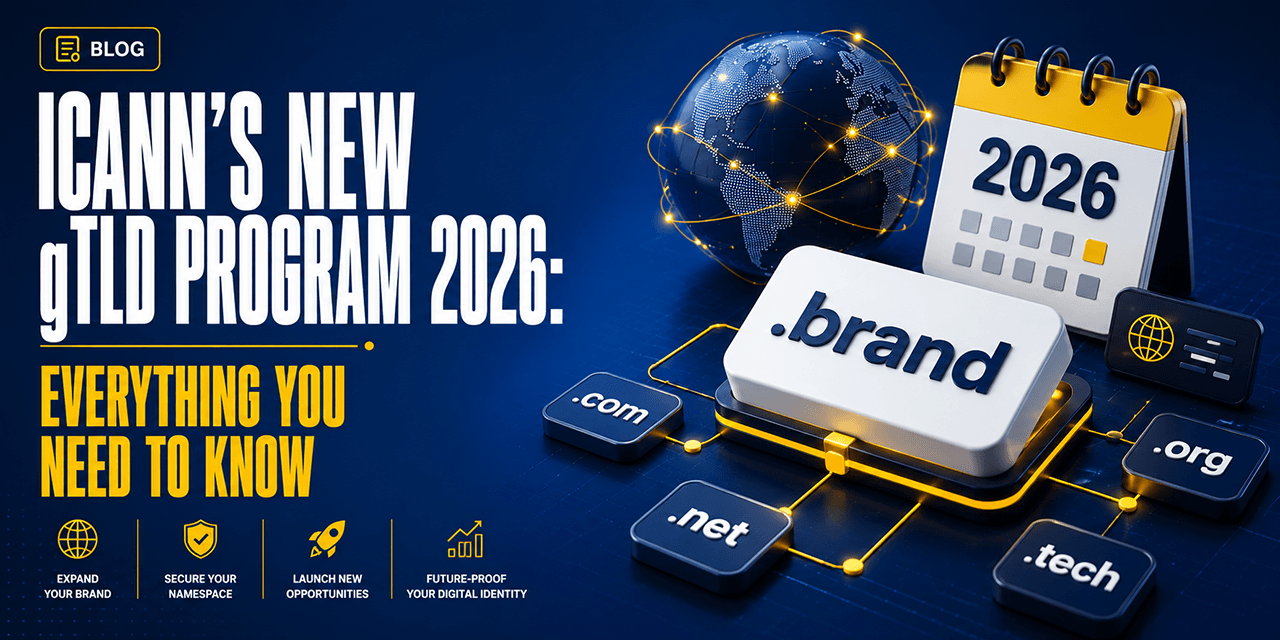
The ICANN New gTLD Program 2026 allows eligible businesses, brands, communities, cities, and registry operators to apply for and operate their own generic top-level domains (gTLDs). This is the first major application round since 2012 and could significantly expand the domain name landscape.
Applications opened on 30 April 2026 and will remain open until 12 August 2026 through ICANN’s TLD Application Management System (TAMS). For organizations seeking greater brand control, stronger digital identity, or new business opportunities, the 2026 round represents a significant opportunity.
What Is a gTLD?
A gTLD (generic top-level domain) is the extension at the end of a domain name, appearing after the final dot. For example, in example.com, the gTLD is .com.
Traditional gTLDs include well-known extensions such as .com, .net, .org, .info, and .biz, which have been widely used since the early days of the internet.
In addition to these, new gTLDs were introduced through ICANN’s New gTLD Program to expand the domain name system. These include custom and industry-specific extensions such as .google, .bmw, .shop, .app, and .nyc, which offer more branding and naming flexibility.
The purpose of the New gTLD Program is to increase choice, competition, and innovation within the domain name system. According to ICANN’s Applicant Guidebook, the program supports its mission to coordinate the DNS and promote a more competitive domain registration ecosystem.
What Is ICANN’s New gTLD Program?
The ICANN New gTLD Program is the next application round that allows eligible organizations to apply for and operate new generic top-level domains (gTLDs). It is the first major opportunity for new applications since ICANN’s 2012 round.
Through this program, approved applicants can manage their own domain extension and operate the underlying registry infrastructure. This means they gain full responsibility for how domains under that extension are created, managed, and governed.
For example, a company may apply for a branded extension like .brandname, a city may apply for .cityname, or an industry group may apply for a category-specific extension tailored to its sector.
ICANN released the updated 2026 Round Applicant Guidebook on 24 April 2026, which serves as the official roadmap for the application process. It outlines eligibility requirements, application questions, evaluation criteria, submission procedures, and program rules.
Key Dates for the ICANN New gTLD Program 2026
The most important dates applicants should know are:
- Application window opens: 30 April 2026
- Application window closes: 12 August 2026
- Evaluation fee payment deadline: Within 7 days after the application window closes
The ICANN New gTLD Program 2026 application period runs from 30 April 2026 to 12 August 2026. After submission, applicants receive an invoice for the evaluation fee, which must be paid within seven days of the closing date. If payment is not received within this timeframe, ICANN may cancel the application.
How Much Does It Cost to Apply for a New gTLD?
The standard ICANN evaluation fee for the New gTLD round is USD 227,000 per application. This fee includes one primary string application and may also cover up to four allocatable variant strings. In certain cases, additional fees may apply for extra evaluations or variant requests. (New gTLD Program)
Applicants approved under ICANN’s Applicant Support Program (ASP) may receive a discount ranging from 75% to 85% on the evaluation fee. (New gTLD Program)
However, the ICANN fee represents only the starting cost. Organizations must also consider the full cost of preparing, launching, and operating a gTLD, which includes:
- Legal advisory and application consulting
- Technical registry setup and infrastructure planning
- Registry Service Provider (RSP) costs
- Brand protection and trademark strategy
- Policy development and compliance planning
- Operational and security readiness
- Marketing and launch activities
In most cases, the total cost of successfully operating a gTLD is significantly higher than the initial ICANN application fee, especially for organizations building long-term registry operations.
Who Can Apply for a New gTLD?
The New gTLD Program 2026 is designed for organizations that have the technical, operational, and financial capability to manage a domain registry. Applicants must be able to demonstrate that they can responsibly operate and maintain a top-level domain within ICANN’s requirements.
Eligible applicants may include a wide range of organizations, such as:
- Corporations and global brands
- Brand owners and intellectual property holders
- Technology companies and internet businesses
- Registry operators and domain industry players
- Cities, governments, and regional authorities
- Communities and nonprofit organizations
- Industry associations and professional bodies
- Financial institutions and service providers
- E-commerce platforms and digital marketplaces
- Media, entertainment, and digital content companies
As part of the application process, organizations must submit detailed information through ICANN’s system, including organizational structure, financial stability, and technical capability. ICANN requires applicants to provide comprehensive responses covering operational, financial, and registry-related readiness to ensure they can successfully manage a gTLD. (New gTLD Program)
Types of gTLD Applications
Applicants can apply for different types of gTLDs depending on their goals, business model, and intended use of the domain extension.
1. Brand gTLDs
A brand gTLD allows a company to operate its own proprietary domain extension. For example, a business may apply for .companyname and use it exclusively for its own digital ecosystem, such as:
- support.companyname
- careers.companyname
- products.companyname
- login.companyname
This approach can improve brand trust, strengthen security, and give organizations full control over their online identity.
2. Generic Keyword gTLDs
Generic keyword gTLDs are based on common industry terms or popular keywords. Examples include:
- .shop
- .cloud
- .finance
- .travel
- .health
These extensions are typically operated commercially by registry operators and can be used to register domains for businesses and individuals within a specific theme or industry.
3. Geographic gTLDs
Geographic gTLDs represent cities, regions, or other geographic areas. These applications often require additional approval, including government or community support, depending on the location and naming rules.
4. Community gTLDs
Community-based gTLDs are designed for clearly defined groups such as professional communities, cultural organizations, or industry associations. Applicants must usually demonstrate that they represent a specific community and that the extension serves their interests.
5. Internationalized Domain Name (IDN) gTLDs
The 2026 round also supports Internationalized Domain Name (IDN) gTLDs, which allow domain extensions in non-Latin scripts such as Arabic, Chinese, Cyrillic, and others. This helps improve global internet accessibility and enables users to use domain names in their native languages.
Why the 2026 New gTLD Round Matters
The domain name system has become more competitive, more brand-sensitive, and more security-focused. A custom gTLD can give an organization more control over its digital ecosystem.
Here are the biggest reasons the 2026 round matters.
1. Stronger Brand Control
A custom gTLD gives brands more control over their digital identity. Instead of relying only on third-party extensions, companies can create a trusted namespace that they manage directly.
For example, a financial institution using login.bankbrand may create a stronger trust signal than a long or confusing domain on a traditional extension.
2. Better Customer Trust
Phishing, fake websites, and domain abuse remain major problems online. A closed or carefully managed brand gTLD can reduce confusion by making it easier for users to identify official websites.
If a company controls all domains under its branded extension, customers can more easily recognize authentic digital properties.
3. More Naming Flexibility
Many premium .com domains are already taken or expensive. A new gTLD creates a fresh namespace where brands can use short, clean, and memorable domain names.
For example:
- buy.brand
- help.brand
- app.brand
- store.brand
- partners.brand
This gives companies more freedom to organize campaigns, products, regions, and customer portals.
4. Competitive Advantage
A successful gTLD application can become a long-term digital asset. Businesses that apply early may secure extensions that competitors cannot easily replicate.
For registry operators, generic keyword gTLDs may also become valuable commercial products if they serve a strong market demand.
5. Industry and Community Identity
Industry groups, professional communities, and cities can use gTLDs to create trusted online spaces.
For example, a community-specific extension can help members, businesses, institutions, and users connect under a shared digital identity.
How the Application Process Works
The application process is detailed and requires preparation. While every application may differ, most applicants will move through the following stages.
Step 1: Review the Applicant Guidebook
The Applicant Guidebook is the most important document for the 2026 round. It explains eligibility, application questions, fees, evaluation, objections, contention, and other program requirements. ICANN describes the guidebook as the essential roadmap for parties interested in applying for new gTLDs.
Step 2: Choose the Right gTLD String
Applicants must decide which domain extension they want to apply for. This decision should be based on:
- Brand strategy
- Trademark rights
- Market demand
- User clarity
- Legal risk
- Long-term business goals
- Potential conflicts with other applicants
Choosing the wrong string can create legal, marketing, or operational challenges.
Step 3: Prepare Business and Financial Information
Applicants must demonstrate that they have the financial ability to support the proposed registry. This includes planning for application costs, technical operations, compliance, ongoing registry expenses, and potential launch costs.
Step 4: Select an Evaluated Registry Service Provider
A Registry Service Provider, or RSP, handles technical registry functions. ICANN states that all new gTLD applicants are required to use evaluated RSPs. The RSP Evaluation Program runs alongside the New gTLD Program.
Step 5: Submit the Application Through TAMS
Applications must be submitted through ICANN’s TLD Application Management System. ICANN’s announcement confirms that applicants must submit applications through TAMS before the application window closes.
Step 6: Pay the Evaluation Fee
The standard evaluation fee is USD 227,000 per application and must be paid by the required deadline. ICANN states that payment must be received no later than seven days after the close of the application submission period.
Step 7: Application Evaluation
ICANN evaluates applications based on the requirements in the Applicant Guidebook. This can include business, financial, technical, legal, string, and operational reviews.
Step 8: Objections, Contention, and Resolution
If multiple applicants apply for the same or similar strings, they may enter contention. Objections may also be filed in certain cases, such as legal rights concerns, community objections, or public interest issues.
Step 9: Contracting and Delegation
If the application is approved and all requirements are completed, the applicant may move toward contracting with ICANN and eventual delegation of the gTLD into the DNS root zone.
What Is a Registry Service Provider?
A Registry Service Provider is the technical backend operator that supports a gTLD. The RSP may manage critical registry functions such as:
- DNS services
- Domain registration systems
- DNSSEC
- RDAP services
- Data escrow
- Technical compliance
- Registry infrastructure
ICANN’s RSP Evaluation Program assesses organizations on the technical aspects of operating a gTLD, and new gTLD applicants must use evaluated RSPs.
For many applicants, choosing the right RSP is one of the most important decisions in the process.
Benefits of Applying for a New gTLD
A new gTLD can offer strategic value, especially for organizations with long-term digital growth plans.
Brand Authority
Owning a custom extension can position a company as a digital leader in its category.
Trust and Security
A controlled namespace can help reduce phishing risks and improve customer confidence.
Better Digital Organization
Companies can organize websites, campaigns, regions, and services under a clean domain structure.
Market Differentiation
A unique extension can help a brand stand out in a crowded online marketplace.
Revenue Potential
Generic gTLD operators may be able to generate revenue by selling domain registrations.
Long-Term Digital Asset
A gTLD can become a valuable part of a company’s intellectual property and digital infrastructure.
Risks and Challenges of Applying for a New gTLD
While the opportunity is significant, the process is not simple. Applicants should carefully consider the risks.
High Application Cost
The base evaluation fee is USD 227,000 per application, not including legal, consulting, operational, and technical costs.
Complex Requirements
Applicants must understand ICANN rules, registry operations, compliance requirements, and technical standards.
Possible String Contention
If another applicant applies for the same or confusingly similar string, the application may face delays or additional resolution steps.
Legal and Trademark Issues
Applicants should review trademark rights, geographic terms, restricted words, and possible objections before applying.
Ongoing Registry Responsibilities
Operating a gTLD is not a one-time project. It requires long-term technical, financial, policy, and compliance management.
How Businesses Should Prepare
Organizations interested in the 2026 round should act quickly and strategically.
1. Define the Business Case
Before applying, clarify why the gTLD matters. Is it for brand protection, revenue generation, customer trust, community identity, or long-term digital strategy?
2. Conduct a String Risk Assessment
Review whether the desired gTLD string may create legal, linguistic, geographic, or competitive issues.
3. Review Trademark Position
Brand owners should confirm whether they have the necessary rights and documentation to support their application.
4. Build a Financial Plan
Applicants should budget beyond the ICANN fee. Consider advisory, technical, legal, compliance, launch, and ongoing operational costs.
5. Choose the Right Registry Partner
A strong technical partner can reduce operational risk and improve application readiness.
6. Prepare Internal Stakeholders
Legal, marketing, IT, security, finance, and leadership teams should all understand the purpose and responsibilities of applying for a gTLD.
7. Move Before the Deadline
The application window closes on 12 August 2026. Late submissions will not be accepted once the round closes.
What Does the ICANN New gTLD Program Mean for Domain Investors?
For domain investors, the 2026 round may reshape the domain market. New extensions can create fresh opportunities, but they may also increase competition.
Investors should watch for:
- New commercial gTLD launches
- Premium domain release strategies
- Industry-specific extensions
- Brand protection trends
- Secondary market activity
- Registry pricing models
- Sunrise and early access periods
Not every new gTLD will become successful. The strongest opportunities will likely come from extensions with clear demand, strong positioning, trustworthy registry management, and practical use cases.
What Does It Mean for Brand Owners?
Brand owners should pay close attention even if they do not plan to apply.
Why? Because competitors, industry players, or third parties may apply for strings related to important categories, markets, or communities.
Brand owners should consider:
- Monitoring applied-for strings after publication
- Reviewing trademark protection options
- Preparing objection strategies if necessary
- Evaluating defensive registration needs
- Considering whether a branded gTLD supports long-term strategy
For major brands, this may be the most important domain strategy decision since the 2012 round.
Is a New gTLD Good for SEO?
A new gTLD does not automatically guarantee higher search rankings. Search engines generally evaluate websites based on relevance, quality, authority, technical performance, content, and user experience.
However, a custom gTLD can indirectly support SEO and digital marketing by improving:
- Brand trust
- Click-through rates
- Domain memorability
- Campaign structure
- User confidence
- Content organization
For example, a clean and trusted domain like support.brand may perform better from a branding and usability perspective than a long, complicated subdomain or unrelated domain extension.
Should You Apply for a New gTLD in 2026?
A new gTLD may be worth considering if your organization:
- Has a strong brand or community identity
- Wants greater control over its digital namespace
- Has the budget for application and long-term operations
- Needs stronger customer trust and security
- Wants to create a new domain registry business
- Has a clear strategy for using the extension
- Can manage compliance and technical responsibilities
It may not be the right choice if your organization only wants a single website, has limited budget, or does not have a clear long-term use case.
FAQs About ICANN’s New gTLD Program 2026
What is ICANN’s New gTLD Program 2026?
It is ICANN’s application round for 2026 that allows eligible organizations to apply for and operate new generic top-level domains (gTLDs). The application window runs from 30 April 2026 to 12 August 2026.
How much does it cost to apply for a new gTLD?
The standard ICANN evaluation fee is USD 227,000 per application. Additional costs may apply depending on evaluation type, variant strings, or special requirements.
Where do applicants submit a new gTLD application?
Applications must be submitted through ICANN’s TLD Application Management System (TAMS) during the official application window.
What is the deadline for the 2026 New gTLD application round?
The application period closes on 12 August 2026. Late submissions are not accepted.
Do applicants need a Registry Service Provider?
Yes. ICANN requires all applicants to use an evaluated Registry Service Provider (RSP) to handle technical registry operations.
Can a company apply for its own brand extension?
Yes. Companies can apply for branded gTLDs (such as .brandname) if they meet ICANN’s technical, financial, and operational requirements.
Is a new gTLD useful for SEO?
A new gTLD does not directly improve rankings, but it can support branding, trust, click-through rates, and user experience, which may indirectly benefit SEO performance.
Is the ICANN application fee refundable?
Refund eligibility depends on ICANN’s policies and the stage of withdrawal. Applicants should review the official Applicant Guidebook for full details.
What should businesses do before applying?
Businesses should carefully review the Applicant Guidebook, select the right string, assess legal and financial risks, choose a qualified RSP, and prepare a long-term registry strategy.
Final Thoughts
The ICANN New gTLD Program 2026 is a major opportunity for organizations that want to own and operate a new part of the internet’s naming system. With the application window open from 30 April 2026 to 12 August 2026, interested applicants have a limited time to prepare and submit their applications.
For brands, cities, communities, and registry businesses, a new gTLD can become a powerful digital asset. However, the process requires careful planning, strong documentation, technical readiness, and a realistic budget.
Whether you are considering a branded extension, a generic keyword gTLD, or a community-based namespace, the best approach is to start with strategy. A new gTLD is not just a domain extension; it is a long-term commitment to operating a trusted digital space.
This guide is published by Hashedomains to help businesses understand and prepare for the ICANN New gTLD Program 2026.