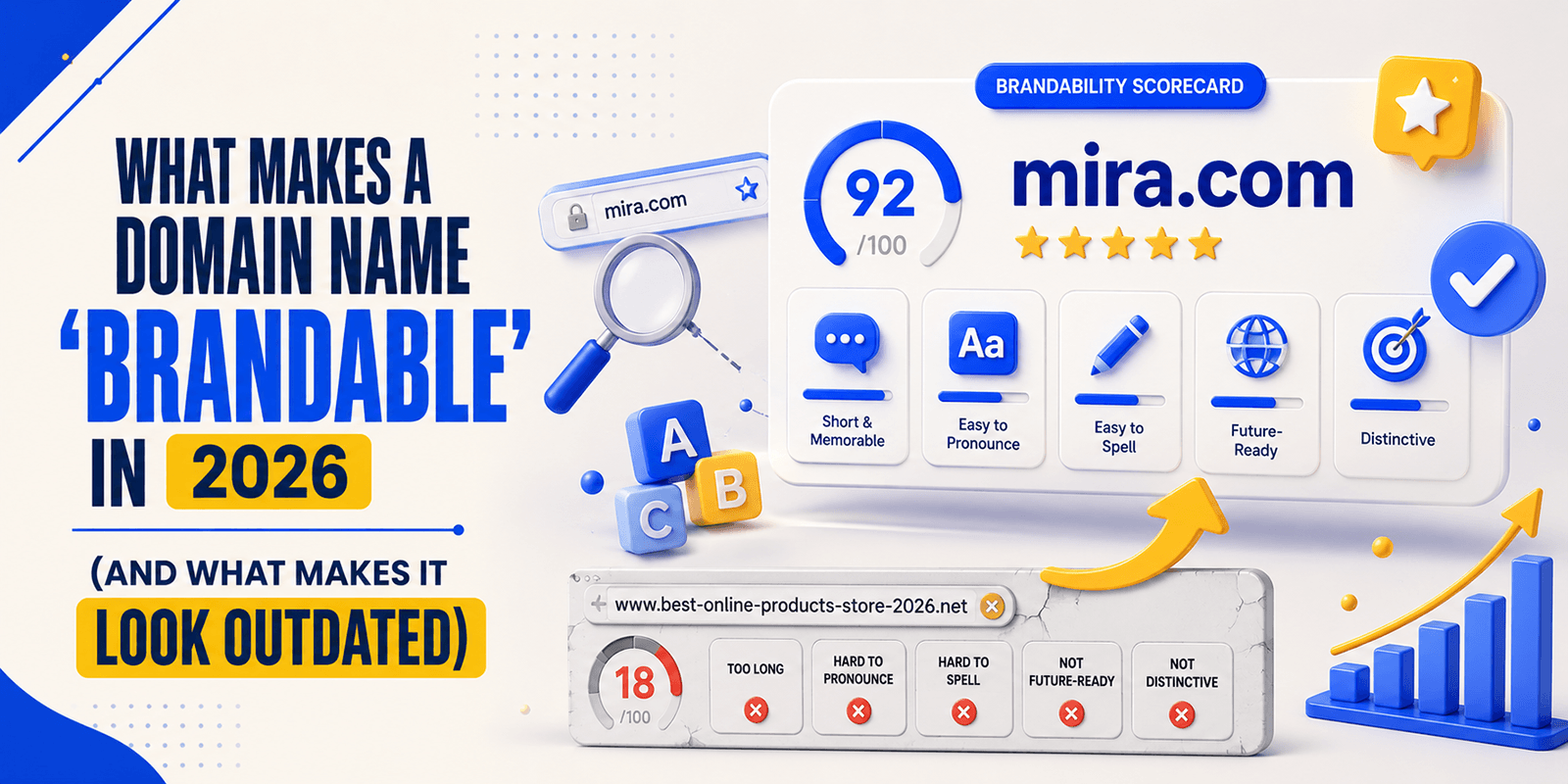
Consider two domain names: best-web-design-agency-uk.com and Verko.co.
Both belong to web design agencies. Both have functional, working websites with the same quality of content. But the moment a user sees one of them in a search result, a social media bio, or on a business card, their brain has already made a judgment.
The second one feels like a real company. The first one feels like a 2009 SEO experiment that survived past its expiry date.
This is the new reality of domain names in 2026. A domain is no longer just an address; it is a brand signal, a trust indicator, and a first impression that users form before they have visited a single page of your website.
According to AtomRadar’s 2026 research, 77% of consumers say a domain name is important or very important when evaluating a brand online. That same study found that 76% of people are more likely to trust a brand whose domain extension they recognise. Your domain name is not a technical afterthought. It is a psychological signal.
In this guide, we will break down exactly what makes a domain name brandable in 2026, what makes one feel outdated and untrustworthy, and how to audit your own domain against both standards.
What Does “Brandable” Actually Mean?
The word “brandable” is used constantly in the domain industry, but it is rarely defined precisely. So let us start there.
A brandable domain name creates instant, positive associations in the mind of the person who sees or hears it, without requiring any explanation. It is short enough to remember. Clean enough to type without hesitation. Distinctive enough to stand out. And flexible enough to represent a business even as it grows and evolves.
Think about the names that built some of the most valuable companies in the world:
- Spotify: Not a music word. Not a keyword. A made-up name that feels modern and energetic.
- Stripe: A single common word, used in an unexpected context, clean and memorable.
- Canva: Slightly invented, easy to say, easy to spell, flexible enough to represent any creative tool.
- Notion: An ordinary word, used with unusual clarity, that evokes organisation and ideas.
- Zoom: Four letters. One syllable. Evokes speed. Now a verb in everyday language.
None of these names tell you exactly what the product does. But all of them feel instantly credible, modern, and trustworthy. That is the goal of a brandable domain.
The opposite, a domain built around exact keyword matching like bestvideocallingsoftware.com or online-design-tool-free.com, tells you what the product does, but feels transactional, forgettable, and in 2026, quietly suspicious.
The Psychology Behind Domain Name Perception
Your brain processes domain names the same way it processes faces, storefronts, and product packaging, fast, automatic, and largely below the level of conscious thought.
Psychologists who study this phenomenon call it processing fluency: the ease with which your brain processes information. The easier something is to process, the more positively you tend to feel about it. The more cognitive effort a name requires, the more friction and mild distrust it generates, even if you cannot articulate why.
High Processing Fluency = High Trust
Premium, brandable domain names score high on processing fluency. They are short. The syllables flow naturally. The spelling is predictable. The word or phrase feels complete and intentional. Your brain processes them instantly and returns a verdict: “This feels legitimate.”
Low Processing Fluency = Instant Friction
A domain like best-web-design-4u-cheap.com requires your brain to do several things at once: parse the hyphens, interpret the number, process the keyword pile, and reassemble the whole thing into a coherent identity. That cognitive effort translates directly into hesitation, and hesitation translates into distrust.
Key Stat: Premium domains score high on processing fluency; they are short, smooth, and visually clean. Processing fluency equals trust. Low fluency equals mental friction, which equals distrust. (Source: AIDOR.xyz domain psychology research)
This psychological dynamic is not academic. It plays out in real, measurable behaviour every time a user decides whether to click a search result, whether to share a URL on social media, or whether to return to a website they visited before. Your domain name is involved in all of these decisions, invisibly, instantly, and permanently.
The 7 Characteristics of a Truly Brandable Domain in 2026
Based on the research, industry data, and observed patterns across successful digital brands in 2026, here are the characteristics that consistently define a brandable domain name:
1. Short Enough to Remember Without Writing It Down
Length is one of the most reliable indicators of brandability. The strongest domain names in 2026 are typically between 5 and 14 characters, short enough to remember after hearing them once, short enough to type on a mobile keyboard without frustration, and short enough to fit cleanly in a social media bio, a business card, or a printed advertisement.
Google.com, 6 characters. Apple.com, 5 characters. Canva.com, 5 characters. Notion.so, 6 characters. The pattern is consistent: the world’s most recognised digital brands overwhelmingly chose short names.
Example: If a name is over 20 characters, users will almost certainly shorten it, mistype it, or simply not bother typing it manually. Under 15 characters is the target range; under 10 is even better.
2. Easy to Spell After Hearing It Once
A domain that passes the “radio test”, where someone hears it spoken aloud and can correctly type it without seeing it written, is genuinely brandable.
This test eliminates creative misspellings, homophones, and any name where you would need to clarify: “That’s Kriativ with a K,” or “It’s flour like the flower, not floor.” Every time a user has to ask how to spell your domain, you have created friction that costs you traffic, memorability, and credibility.
Watch Out: Creative spellings feel clever in a brand brainstorm and feel like a mistake in everyday use. If you have to explain the spelling, it is the wrong name.
3. No Hyphens, Numbers, or Special Characters
This is one of the clearest dividing lines between modern brandable domains and outdated keyword-era domains. Hyphens, numbers, and unusual characters carry decades of accumulated spam stigma that individual websites simply cannot overcome.
Domains like best-hair-salon.com or design4u247.com are harder to remember, harder to say out loud, harder to type correctly, and, critically, they look like the kind of domains that were built in 2004 to game keyword rankings, not like domains that belong to credible businesses in 2026.
Research confirms this clearly: hyphenated domains are consistently perceived as less trustworthy and more spammy, not because Google penalises them directly, but because users do. Lower click-through rates, lower direct traffic, and weaker backlink acquisition all follow naturally from the trust deficit that hyphens create.
Pro Tip: Google’s John Mueller has confirmed that hyphens do not directly harm SEO rankings. But the real damage is behavioural: users click less, share less, and link less. That behaviour compounds into ranking suppression over time.
4. Flexible Enough to Grow With the Business
One of the most common and most painful domain mistakes is locking a business name to a hyper-specific product, location, or moment in time.
A yoga instructor who registers manchesteryoga2024.com has three problems built into one domain: a city that limits geographic expansion, a specific discipline that limits service expansion, and a year that becomes outdated immediately. The domain traps the business before it has had a chance to grow.
The strongest brandable domains are intentionally flexible. They represent a feeling, a concept, or a brand identity broad enough to survive pivots, expansions, and market evolution. Shopify does not say “ecommerce”. Slack does not say “messaging”. Stripe does not say “payments”. All of them could expand into adjacent areas, and have, without their domain name becoming a liability.
5. Visually Clean in a URL
Brandability is not just about how a name sounds. It is also about how it looks in a browser bar, in a search result snippet, in an email signature, and in the body of a message.
A clean URL like verko.co looks intentional and professional at every touchpoint. A crowded URL like best-verko-design-services-2026.co.uk looks chaotic in a search result snippet, gets truncated in email signatures, and creates visual noise that users subconsciously associate with lower quality.
6. Passes the Brand Name Test
Ask yourself: could this domain name double as a company name on a pitch deck, a VC funding announcement, or a Forbes profile?
Brandable domains do not just work as web addresses. They work as brand names in every context where a business name appears. If your domain name would look out of place as a company name on a legal document or a product box, it probably is not brandable enough.
7. Has a Clean Extension That Matches the Brand
In 2026, the domain extension is part of the brand. .com remains the gold standard for trust and global recognition; 76% of users are more likely to trust a brand whose domain extension they recognise, and .com leads that recognition by a wide margin.
But modern extensions have carved out genuine credibility in specific contexts. .ai signals artificial intelligence and tech innovation. .co is widely accepted as a clean alternative to .com for startups. .io remains popular among developer tools and B2B SaaS. .org conveys a non-profit mission and community purpose.
What undermines brandability is a mismatch between extension and brand identity, a luxury fashion brand on .biz, a fintech startup on .info, or any business on an unfamiliar, obscure extension that users have never seen before.
What Makes a Domain Look Outdated in 2026
Just as there are clear signals of a brandable domain, there are equally clear signals that make a domain look like it belongs in a different era of the internet. These are not just aesthetic concerns; they create real, measurable friction that affects user trust, click-through rates, and long-term brand perception.
| Outdated Signal | Why It Hurts Your Brand in 2026 |
| Multiple hyphens | Immediately evokes the spammy keyword domains of the early 2000s. Reduces CTR and user trust on the site. |
| Numbers as words (4u, 2day, b4) | Creates confusion (is it the number or the word?), looks juvenile, and reads as low-effort branding. |
| Random numbers (247, 123, 99) | Looks either like a spam site or a desperate availability workaround. Undermines professionalism. |
| Location modifiers (bestplumberinlondon) | Traps the brand geographically. Looks like an old local SEO tactic rather than a real business name. |
| Keyword-stuffed EMDs | Exact-match domains like buycheapshoes.com signal the SEO tactics of 2010, not a credible brand in 2026. |
| Excessively long names (20+ chars) | Hard to remember, hard to type, and truncated in search results, all of which signal low trust. |
| Unusual TLDs with no brand fit | .biz, .info, and unfamiliar extensions carry low-trust associations from their early adoption by spammy sites. |
| Creative misspellings as a workaround | Kreativ, Shoppe, Nite, clever in isolation, problematic in everyday use when users misspell the misspelling. |
| Year stamps in the domain | 2024, 2026, sounds relevant for one year and outdated forever after that. |
The consistent theme across these signals is the same: they prioritise keyword matching or short-term availability over long-term brand credibility. They were rational decisions in a different era of the internet. In 2026, they are visibility liabilities.
The Real-World Cost of an Outdated Domain
The impact of a poorly branded domain is not theoretical; it shows up in measurable business metrics.
Lower Click-Through Rates in Search Results
Google displays your domain name in search results, and users make click decisions partly based on how trustworthy that domain looks. A domain that looks spammy or cluttered will receive fewer clicks than a clean, brandable one, even when the content, meta description, and headline are identical.
Lower CTR sends a negative engagement signal to Google over time, which can compound into lower rankings, a direct SEO consequence of a branding problem.
Higher Bounce Rates
Users who arrive at a website after seeing a cluttered or suspicious-looking domain are more likely to leave quickly. The visual expectation set by the domain, spammy or low-quality, primes users to interpret everything on the site through that lens. If the homepage does not instantly overcome that first impression, users bounce.
Weakened Word-of-Mouth and Sharing
Word-of-mouth is one of the most powerful growth channels for any business. But a domain with hyphens, unusual spelling, or excessive length is almost impossible to share verbally. “Visit best-design-agency-uk.com” is an instruction that loses information every time it is spoken.
This friction quietly suppresses one of the most organic and high-converting channels available to a growing business.
Fewer Organic Backlinks
Bloggers, journalists, and content creators who link to external sites instinctively choose to link to domains that look credible. A domain that looks spammy or cluttered attracts fewer editorial links, directly weakening the backlink profile that underpins long-term SEO performance.
Key Stat: Hyphenated domains and keyword-stuffed domains are almost always valued lower in domain resale markets, reflecting the market’s own assessment of their reduced credibility and audience trust.
Is Your Domain Brandable? Run This Audit Right Now
Score your current or prospective domain against this checklist. Be honest, each item reveals a real signal about how users will perceive your brand.
| ✓ | Question | What to Look For |
| □ | Is it under 15 characters? | Shorter is almost always stronger. Over 20 is a red flag. |
| □ | Can someone spell it correctly after hearing it once? | If not, it will lose you traffic every time it is spoken aloud. |
| □ | Does it avoid hyphens? | Even one hyphen introduces trust friction. Multiple hyphens are a serious branding liability. |
| □ | Does it avoid numbers? | Meaningful numbers (24/7, B2B) are acceptable. Random digits look spammy. |
| □ | Does it avoid creative/unusual spellings? | Clever in a brainstorm; confusing in real life. |
| □ | Is it flexible enough to survive business pivots? | Does it trap you in a location, niche, or time period? |
| □ | Does it look clean as a full URL in a browser bar? | Test it visually. Does it look professional at a glance? |
| □ | Would it work as a company name on a pitch deck? | If not, it is probably not brandable enough. |
| □ | Does the extension match the brand and audience? | Mismatched extensions undermine the credibility the name builds. |
| □ | Is it available on major social platforms too? | Brand consistency across channels requires handle alignment. |
If you answered yes to 8 or more of these questions, your domain is solidly brandable for 2026. If you answered no to 3 or more, it is worth reconsidering, especially if your business is still early enough that a domain change would not require major rebranding.
What to Do If Your Current Domain Looks Outdated
Discovering that your domain looks outdated can be unsettling, especially if you have spent years building authority on it. Here is a measured, practical approach:
Option 1: Evaluate Whether the Problem Is Actually Hurting You
Not every imperfect domain is a crisis. If your domain has strong authority, an established audience, and good organic traffic, the cost of rebranding may outweigh the benefit. Run a CTR audit in Google Search Console: if your click-through rates are healthy and improving, your domain may not be the limiting factor.
Option 2: Register a New Brandable Domain and Redirect
If you are in an early stage, or if the evidence suggests your domain is genuinely suppressing growth, registering a cleaner domain and implementing 301 redirects is the most direct solution. A properly executed domain migration preserves most of your existing SEO authority while giving you a stronger brand foundation going forward.
Plan the migration carefully: update all internal links, submit the new sitemap to Google Search Console, update all backlinks where possible, and monitor rankings closely for 60 to 90 days after the move.
Option 3: Use the New Domain Alongside the Old One
Some businesses register a new, brandable domain and use it primarily for marketing, advertising, and social media, pointing it to the existing domain while gradually building equity on the new one. This allows a softer transition without the abrupt disruption of a full migration.
Pro Tip: Whatever you decide, register the brandable domain you actually want now, before someone else does. Good short brandable names disappear fast, and the cost of registering and holding them is minimal compared to the value of having them available when you are ready.
Frequently Asked Questions
What is a brandable domain name?
A brandable domain name is short, memorable, easy to spell and pronounce, and flexible enough to represent a business across different contexts and over time. It creates positive first impressions without requiring explanation, similar to how brand names like Spotify, Stripe, or Notion work.
Why do hyphens make a domain look outdated?
Hyphens became strongly associated with spammy, low-quality keyword-stuffing domains in the early days of SEO. That stigma has persisted despite the internet evolving significantly. Users subconsciously associate hyphenated domains with untrustworthy sites, which reduces click-through rates and sharing, both of which indirectly affect SEO performance over time.
Does having a brandable domain help with SEO?
Not directly, Google does not rank brandable domains higher than keyword domains as a direct signal. The benefit is indirect but significant: brandable domains generate higher click-through rates, more organic shares, stronger backlink profiles, and higher user engagement, all of which are signals Google uses to determine trustworthiness and relevance.
Is it too late to change my domain if it looks outdated?
It depends on how established your domain is. If you have significant domain authority and organic traffic, a migration should be planned carefully to minimise ranking disruption. If you are in an early stage or just starting, switching now is low-risk and high-reward. Either way, the first step is to register the brandable domain you actually want before it becomes unavailable.
What domain extension is most brandable in 2026?
.com remains the most trusted and recognised extension globally, and the most brandable choice for most businesses. Modern extensions like .co, .ai, .io, and .tech have earned genuine credibility in specific contexts. What undermines brandability is an extension that feels unfamiliar to users or mismatched with the brand’s industry and audience.
How short should a brandable domain be?
Aim for between 5 and 15 characters as a practical target range. Under 10 characters is ideal but increasingly difficult to achieve with available names. The key test is memorability: can someone remember the domain after hearing it once? If not, it is probably too long or too complex.
Can a keyword domain ever be brandable?
Occasionally, yes, if the keyword is short, the combination is genuinely memorable, and the domain does not look keyword-stuffed. However, the bar is high. Most keyword domains prioritise search relevance over brand identity, and in 2026, that trade-off increasingly hurts rather than helps. When in doubt, choose brandability over keywords.
Final Thoughts: Brandability Is a Business Decision, Not a Vanity Choice
The gap between a brandable domain and an outdated one is not just aesthetic. It is functional. It affects whether users click your search result, whether they return to your site, whether they recommend you to others, and whether journalists and bloggers choose to link to you.
In 2026, search engines and users alike are more sophisticated than ever. The era of exact match keyword domains gaming Google is definitely over. The era of brand authority, trust, recognition, and credibility is fully underway.
Your domain name is the foundation of your brand’s online identity. Getting it right from the start, or upgrading it when the evidence demands it, is one of the highest-return decisions a business owner can make.
The best domains do not just work technically. They build trust the moment someone sees them. That trust compounds with every click, every share, every backlink, and every returning visitor, quietly, permanently, and profitably.
Ready to find your brandable domain name?
Search for short, memorable, available domain names across hundreds of extensions at HashedDomains.com, and claim yours before someone else does.